
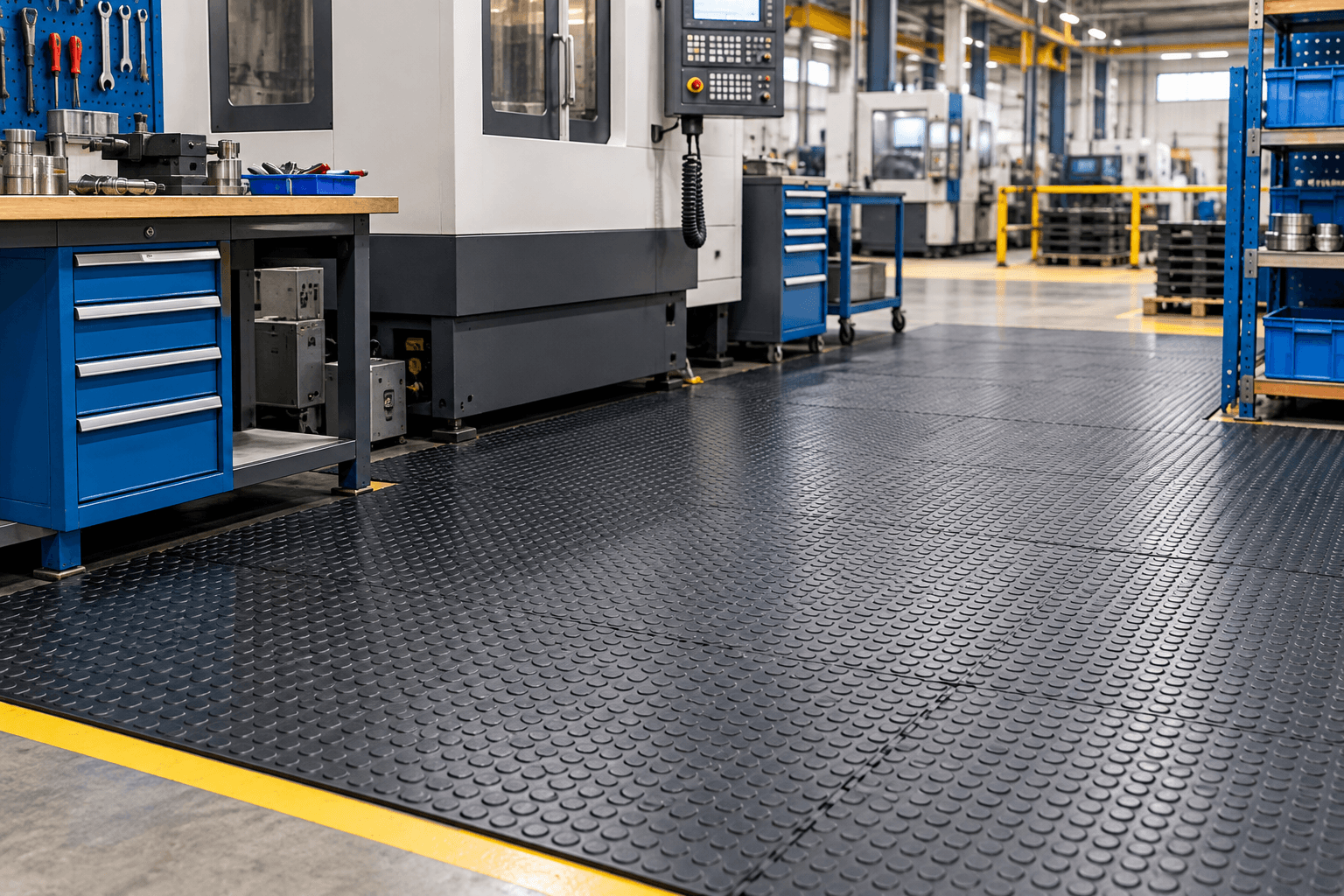
Industrial rubber mats serve different purposes around machinery, workbenches, wet areas and specialist workplaces. Choosing one starts with the task and operating conditions, then checking whether a particular product documents the functions needed there. A factory setting alone does not define the specification.
This guide explains industrial mat types and the decisions that distinguish them. Use the examples to prepare a requirement, then visit the industrial range to compare products and enquire about a suitable configuration.
What Are Industrial Rubber Mats?
Industrial rubber mats are application-specific floor coverings or working-area products. They may provide a defined standing position, connected coverage or a continuous strip beside equipment. Their purpose depends on the individual construction and documented properties, rather than the broad industrial label.
Industrial rubber matting is not necessarily a complete permanent industrial flooring system. When a brief asks for industrial rubber flooring, clarify whether it means removable workplace mats, modular tiles or a wider floor specification. Establish the area being covered and the function expected before comparing surface patterns or dimensions.
Why “Industrial Mat” Is Not One Product Type
General floor coverage, standing support and anti-fatigue performance are separate requirements. So are grip, drainage, moisture management and compatibility with oil or grease. A connected edge explains how coverage fits together; it does not establish cushioning or resistance to process fluids.
Specialist functions need equally clear separation. Welding use does not automatically establish fire-retardant performance. ESD charge control and electrical insulation have different purposes. An ordinary rubber surface should not be selected for either solely because it is rubber.
Build a short list of required functions and check each against the candidate product. If one property is documented but another is missing, record the gap for confirmation. Avoid combining descriptions from different products into an imaginary all-purpose industrial mat.
Start with the Work Zone and Operating Conditions
Describe the operation: assembly, inspection, machine tending, access beside equipment or another task. Mark where workers stand, turn and move. Include carts and equipment movement, not just the dimensions of the bench. Record the proposed coverage on a simple layout with nearby doors and aisle boundaries.
Identify the existing floor and whether the area is indoors or outdoors, normally dry, intermittently wet or exposed to persistent moisture. Name oils and process fluids separately from water. State any welding, fire-retardant, ESD or electrical-insulation requirement explicitly, with the relevant workplace documentation.
Different zones within one factory may need different products. Keep each zone’s conditions attached to its dimensions so that a specification for one station is not silently extended across the building.
Floor Coverage, Modular Layouts and Machinery Areas
Secure Lock illustrates modular floor coverage: its interlocking rubber tiles have a textured anti-slip surface and allow modular fitting and replacement. The published machinery-related benefit concerns protecting the floor beneath equipment. It does not establish protection of the machinery itself or a load rating.
Work Sure addresses connected indoor workstation coverage with diamond-top texture and close-fitting edges. Its nearly seamless layout minimises transitions underfoot, but that is not guaranteed trip prevention. Its published description does not establish cushioning or anti-fatigue support.
Choose a modular layout because it suits the footprint and access needs, then verify the remaining requirements. Neither connected construction nor a textured face establishes drainage, fluid resistance or suitability for every piece of equipment.
Standing Workstations and Anti-Fatigue Requirements
Standing-area coverage does not automatically establish anti-fatigue support. Where prolonged standing is part of the task, look for that function in the product description rather than assuming every rubber mat provides it.
Work Easy is an explicit industrial anti-fatigue example. Its raised bubble-top cushioning distributes standing pressure, with resilient support described as helping reduce strain during long shifts. It is an indoor mat made from a “Special synthetic blend”. These qualitative statements do not establish medical benefits, a measured ergonomic improvement or compatibility with oils.
For the detailed standing-task assessment and comparison of workstation options, use the anti-fatigue guide. Keep any drainage, fluid exposure or specialist requirement separate in the brief.
Wet Areas: Drainage or Moisture Management?
First describe what needs to happen to the water. Ringmax uses open rings for drainage and has a textured anti-slip surface for its wet-area role. Its openings are a specific construction feature, not evidence of oil or chemical compatibility.
Drainmax is described differently: it is an absorbent rubber matting roll with a textured moisture-management surface. Its published format provides continuous industrial and agricultural coverage. Do not treat it as a through-hole drainage roll or assume it moves liquid in the same way as Ringmax.
Check the water source, the surrounding floor and access beneath the proposed covering. If the liquid contains cleaning chemicals or process residues, those exposures also need review. A requirement for drainage and a requirement for moisture management should be written separately.
Oil, Grease and Industrial-Fluid Exposure
Guard Tech is the industrial oil and fluid example. Its published options include 50%, 80% and 100% NBR, with resistance to swelling around oil and industrial fluids. Those options do not constitute a universal chemical-compatibility statement, and the product record does not provide a fluid-compatibility matrix.
Identify the exact oil or process fluid, how contact occurs and whether it can remain on or beneath the mat. Include cleaning substances in the discussion. Ask for confirmation against that exposure rather than choosing from the word oil-resistant alone.
Grease exposure also needs its own context. A food-service grease requirement should not be assumed equivalent to an industrial lubricant requirement. The material guide explains the broader comparison without replacing product-specific confirmation.
Choose Between Mats, Tiles and Rolls
An individual mat provides a defined footprint, useful when the required coverage is a particular position. Tiles form connected or modular areas, where the layout and joints are part of the selection. Rolls provide continuous coverage along longer zones.
Format does not determine performance. An anti-fatigue mat is not interchangeable with a roll simply because both cover the same area. Likewise, modular fitting does not establish drainage. Compare the function first, then the format that fits the movement and dimensions.
Consider how the proposed sections will be handled and how the floor beneath remains accessible where necessary. Confirm available widths, lengths and configurations before treating a sketch as an achievable installation layout.
Size, Thickness, Surface and Edge Transitions
Measure the working footprint and movement paths, including doors, aisle edges and cart crossings. Compare published dimensions with the whole area used, not only the stationary position. Surface texture and transitions should be reviewed against the actual task.
Dome Max illustrates an edge-related decision: this indoor roll has bevelled sides intended to ease cart and equipment movement. It is published at 90 cm width, cut to any length. That does not establish a wheel-load rating or guarantee trip prevention.
There is no universal best thickness, and thicker is not automatically better. Dome Max and Work Easy do not publish thickness in their current records. Ask for missing dimensions instead of estimating from photographs. Custom sizing should be discussed only for products that offer it, such as Work Easy and Work Sure.
Welding and Fire-Related Requirements
Shield Tech is intended for welding-workstation floor coverage and has a cushioned standing surface. Its published record does not establish heat, spark, molten-metal or fire ratings. Intended welding use should not be expanded into an unlisted performance claim.
Fire Shield Tech is a separate fire-retardant product described as helping limit flame spread. The product information states OTI Austria testing to BFL-S1 for this product. That testing does not apply to Shield Tech or the wider range, and it does not establish welding suitability.
Record welding and fire-related requirements separately, then request the applicable documentation. The welding guide covers the selection questions in more detail; neither a rubber appearance nor a neighbouring product’s rating resolves them.
ESD and Electrical Insulation Are Different Functions
Electra Tech has a conductive ESD charge-control role, discharging to an approved ground. Its record publishes “1 × 10³ to 1 × 10⁶ Ω resistivity”, without full test conditions. Keep that measurement as published and request supporting details rather than reinterpreting it as another electrical property.
Work Insular and Work Hawk instead have electrical-insulation purposes. Work Insular states “Up to 20,000 V breakdown strength”. Breakdown strength is not a working-voltage rating or an electrical class. Work Hawk has no numerical voltage rating in its current product record.
Conductive static control and electrical insulation are different selection purposes. Confirm the required function and product documentation with those responsible for the workplace specification. This comparison is not an installation procedure or a universal electrical-safety assurance.
Cleaning, Inspection and Durability
Include upkeep in the selection brief. Consider physical condition, edges, placement and contamination, together with access beneath matting where appropriate. Changes in the process or substances used nearby may also change the suitability question.
Request product-compatible cleaning instructions. The available records do not establish a universal cleaner, temperature, pressure or cleaning interval for industrial floor mats. Do not transfer a procedure from an unrelated product merely because both use rubber.
Durability should be considered against exposure and use, not an invented replacement schedule. No numerical service life or warranty is established here. Use the durability guide for the wider factors affecting how a mat performs over time.
Highrange Examples: Matching a Requirement to a Function
Use these selected examples to separate what is documented from what still needs checking. They are decision prompts, not a ranking or a complete catalogue.
- Modular floor coverage → Secure Lock establishes interlocking tiles and floor protection beneath equipment. Verify the equipment and loading requirement separately.
- Standing support → Work Easy explicitly establishes anti-fatigue support. Confirm any additional exposure requirement and unpublished thickness.
- Wet-area drainage → Ringmax establishes open-ring drainage. Verify the actual liquid and surrounding floor conditions.
- Oil or industrial fluids → Guard Tech provides documented NBR options and swelling-resistance wording. Confirm compatibility with the named fluid.
- Continuous coverage with cart access → Dome Max establishes a roll format and bevelled sides. Confirm the movement requirement; no wheel-load rating is published.
Industrial Mat Selection Checklist
Prepare a brief for each distinct work zone. Separate confirmed facts from unresolved specifications so the enquiry can address the gaps directly.
- Application and layout: task, coverage dimensions, existing floor, worker movement, and cart or equipment movement.
- Environment: indoor or outdoor placement, dry or wet conditions, water drainage and moisture-management requirements listed separately.
- Exposure: oils, grease and industrial fluids, including the exact substances and how contact occurs.
- Standing requirement: whether coverage alone, standing support or explicit anti-fatigue performance is needed.
- Specialist functions: welding, fire retardancy, ESD/static control and electrical insulation stated individually where relevant.
- Configuration: mat, tile or roll preference, surface and edge needs, quantity and destination; custom size or configuration only where offered.
- Open questions: missing thickness, compatibility information, test documentation, loading requirements and product-compatible care instructions.
Frequently Asked Questions
What are industrial rubber mats used for?
They provide application-specific coverage around workstations, machinery and other industrial zones. Depending on the product, the documented purpose may concern standing support, drainage, fluid exposure or a specialist function. One mat should not be assumed to provide every capability.
How do I choose an industrial rubber mat?
Start with the task, area dimensions, movement and operating conditions. List the functions required, then compare individual product documentation. Treat missing specifications as questions for confirmation before selecting the format and configuration.
Are all industrial rubber mats anti-fatigue?
No. Work Easy explicitly provides anti-fatigue support, while modular coverage or a textured surface alone does not establish that function. Confirm the standing requirement separately from drainage, fluid compatibility and specialist workplace needs.
What is the difference between industrial mats, tiles and rolls?
Mats cover defined footprints, tiles provide connected or modular coverage, and rolls cover continuous lengths. These formats describe layout choices. They do not establish anti-fatigue, drainage or other performance without product-specific evidence.
Which industrial rubber mats are suitable around oil or fluids?
Guard Tech has published NBR options and resistance-to-swelling wording for oil and industrial fluids. Its record does not provide universal compatibility or a fluid matrix. The exact substance and exposure conditions still need review.
Do industrial rubber mats provide drainage?
Some do: Ringmax has open-ring drainage. Drainmax is instead described as absorbent moisture-management matting, not through-hole drainage. Check the individual construction and remember that water handling does not establish chemical compatibility.
Can ordinary industrial rubber mats be used for welding or electrical work?
Do not assume suitability from the industrial label. Shield Tech has an intended welding-workstation role; Electra Tech has an ESD role; Work Insular and Work Hawk have insulation purposes. Verify the specific documentation. Breakdown strength is not a working-voltage rating.
How do I choose the right thickness and size?
Measure the working area, movement paths and edge clearances, then compare published dimensions. There is no universal thickness recommendation. Request unpublished dimensions and confirm supported custom options instead of estimating from images or assuming thicker is better.