
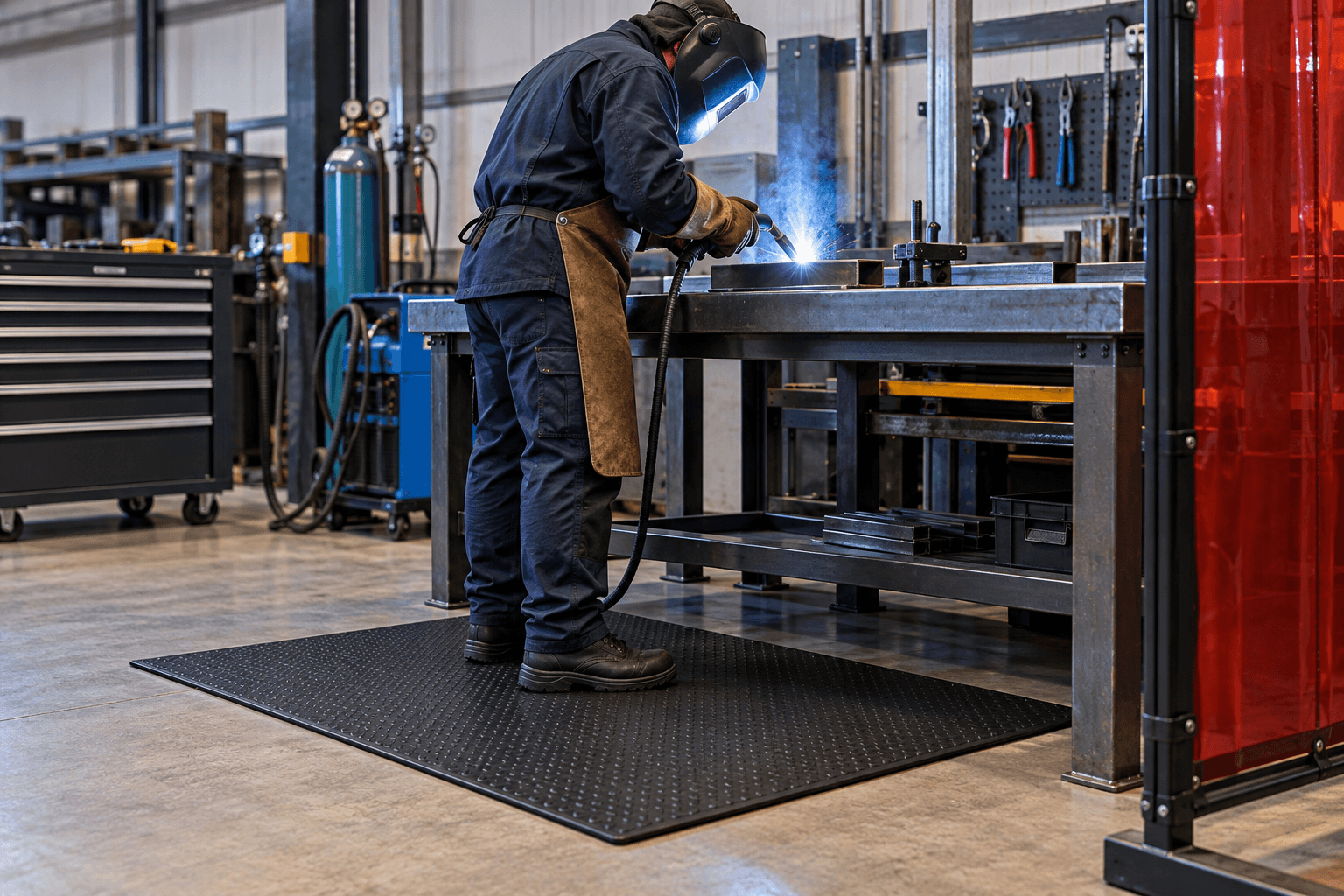
A welding workstation needs a practical floor arrangement as well as the right equipment. The operator may spend long periods standing, move between tools and the workpiece, and share the surrounding area with other workshop activities. Well-chosen matting helps create a defined standing surface that fits those everyday demands.
This guide explains the types, benefits and applications of welding mats, how rubber construction affects the finished product, and what to consider when planning size, placement and maintenance. It also explains what buyers mean by “weld resistant” and uses Highrange Shield Tech as a practical product example.
What Are Weld Resistant Mats?
Weld-resistant mats are floor mats selected for the operator’s standing and working area around a welding workstation. Buyers also call them welding mats, welding floor mats or welding workstation mats. Their practical role is to provide defined floor coverage and, where the construction supports it, a resilient surface for standing work.
The starting point is the space between the operator, the bench and the tools. A mat should fit that working area, allowing the person to stand and move comfortably while keeping the surrounding layout usable. Rubber mats for welding are therefore selected around the job and location, rather than appearance alone.
Floor mats are different from welding blankets and screens, which are selected for other protective roles. A standing mat is not a substitute for either. The phrase “weld resistant” also covers a range of purchasing expectations; the terminology section below explains how to distinguish intended use from a tested resistance property.
Types of Mats Used Around Welding Workstations
Industrial catalogues group mats by different functions. Understanding those functions makes it easier to compare products and avoid buying a comfortable standing mat when the requirement is something more specialised. The following categories are not all automatically welding mats.
Dedicated welding workstation mats
These products are specifically described for welding workstation or welding-area floor coverage. They give buyers a relevant starting point for an enquiry about a designated welding position. Review the available dimensions, environment and stated benefits against the work area. Shield Tech is Highrange’s example in this category.
Welding anti-fatigue and comfort mats
Comfort-focused products emphasise cushioning during prolonged standing. Buyers may encounter them as welding anti-fatigue mats or anti-fatigue welding mats. That wording identifies the standing-comfort objective; it does not by itself describe thermal or spark performance.
General industrial rubber mats
General industrial mats serve purposes such as floor coverage, standing support or drainage. They can be useful elsewhere in the same workshop, but moving one into a welding position changes the application. Check that the proposed use is included in the product’s intended role.
Fire-retardant industrial mats
These address a separate fire-performance requirement. A documented fire-retardant property can be relevant to industrial selection, but it answers a different question from whether a mat is intended for a welding workstation.
Electrical insulating and ESD mats
Electrical insulating mats and electrostatic discharge control mats serve distinct electrical or static-control functions. Where either is required, select around that specific requirement rather than using a general welding or comfort label.
Benefits of Welding Workstation Mats
The most useful benefits relate to everyday work: covering the intended area, supporting the standing position and making the floor arrangement practical to use and maintain.
Defined floor and workstation coverage
A mat creates a recognisable standing area beside a bench or within a workstation. Matching its footprint to the task helps organise where the operator stands and how the covered surface meets the surrounding floor. The extent of floor protection remains a feature of the chosen product, rather than a guarantee against every kind of damage.
A resilient surface during prolonged standing
Cushioning can make a mat a useful addition where an operator spends extended periods on their feet. A consistent surface across the normal working position is particularly helpful when the task involves small changes of stance, rather than frequent steps between covered and uncovered floor.
Practical coverage for the intended environment
Where the product is supplied for removable placement, individual mats can make access to the underlying floor convenient for cleaning and inspection. Products intended for indoor or outdoor use also give buyers options for different designated working positions. Choose the format that suits both daily work and routine handling.
Where Welding Mats Are Used
Welding station mats may be considered wherever a defined operator standing area is useful. The examples below describe possible applications, not blanket approvals for a particular product.
Fabrication benches and production welding cells
At a fixed fabrication bench, start with the position used to prepare, hold and work on the component. In a production welding cell, look at the repeated movements between the workpiece, fixtures and controls. These observations help establish whether one mat covers the normal stance or a different coverage arrangement is needed.
Repair, maintenance and metalworking areas
Repair shops and industrial maintenance facilities often involve several tasks in the same space. Welding may sit alongside grinding, component handling or servicing equipment. Mention associated oils, moisture, debris and electrical requirements when describing the workstation, because they can add selection needs beyond standing comfort.
Designated indoor and outdoor positions
Indoor workshops and outdoor maintenance positions can have different floor and exposure conditions. For outdoor use, describe shelter, wet conditions, the ground surface and storage between jobs. Choose a mat intended for that environment; an indoor/outdoor designation is useful application information, not a separate weathering or drainage rating.
Rubber Materials and Construction for Welding Workstation Mats
Rubber welding mats combine a material formulation with a physical design. Together, these determine how the finished mat feels, fits and is handled. Looking at those elements is more informative than comparing thickness or surface appearance in isolation.
Resilience and cushioning
Resilience describes the material’s ability to deform under a load and recover as that load is removed. In a standing surface, this behaviour contributes to the underfoot feel. The operator still needs stable support while turning, reaching and handling work, so cushioning is considered alongside the overall construction.
Surface design and physical format
Surface patterns affect the contact area and how easily the mat can be cleaned. Dimensions determine the covered footprint, while thickness influences the transition to the surrounding floor. Also consider how the finished mat will be lifted, repositioned and stored if those tasks form part of daily use.
Formulation and the finished product
Rubber compounds and product designs vary between applications. Two black mats with similar patterns can have different intended roles. Compare the finished product’s stated use, construction and care instructions; “rubber” alone is too broad a description to explain performance. The durability guide below explores why material and operating conditions belong in the same discussion.
What Does "Weld Resistant" Actually Mean?
“Weld resistant” is a broad search and purchasing term, not one universal resistance rating. It often signals that a buyer wants matting for a welding area, but the exact requirement still needs to be expressed in practical terms.
Welding suitability and tested resistance
A welding-workstation description tells you the intended application. A tested resistance property tells you how a product performed under stated conditions. For example, floor coverage around a working position and direct exposure to hot material are different requirements. Describe what may reach the mat, including sparks, spatter or hot workpieces, and where it will be placed.
Reading heat- and spark-resistance claims
When comparing heat-resistant welding mats or spark-resistant mats, ask the supplier what the claim covers. Useful information includes the exact product tested, test method, exposure conditions, duration and limitations. A result for another product in the range cannot answer that question. If a required rating is missing, resolve it before purchase rather than relying on the label.
Putting safety language in context
“Weld-safe” or “welding-safe” is not a guarantee that a mat addresses every workplace hazard. Neither rubber generally nor Shield Tech should be described as fireproof, spark-proof, heat-proof or molten-metal-proof. Shield Tech’s published data does not provide temperature, heat, spark or molten-metal ratings, fire certification, oil resistance, electrical insulation or ESD performance.
A mat does not replace PPE, welding screens, ventilation or fume extraction, fire prevention, electrical safety, housekeeping or employer welding procedures. Keep mat selection within the workplace’s established safety arrangements. These boundaries allow the rest of the buying decision to focus on fit, comfort and practical use.
Standing Comfort, Surface Grip and Stability
Comfort across the working position
Welding anti-fatigue mats are often considered for jobs involving prolonged standing. Look for a balance between cushioning and a steady working surface. Discuss the task with the operator: where they stand longest, how often they turn and whether reaching for tools takes them off the mat. Comfort is part of the working arrangement, not a promised medical outcome.
Surface texture and workshop conditions
Consider the surface together with footwear, moisture and process residues. Texture is a visible design feature, while any claimed slip performance needs to relate to the relevant conditions. Keep cleaning practical so debris and contamination can be dealt with. No surface should be presented as universally slip-proof.
Stable placement during movement
The mat should sit properly on the intended floor as the operator changes stance. Look for shifting, rocking or lifting at the edges during normal movement. If placement is unstable, review the floor and installation with the supplier; compatible fixing methods, where offered, belong in the product instructions.
Choosing Thickness, Size and Floor Coverage
Choose thickness as part of the complete mat
There is no universal welding-mat thickness. Consider the underfoot feel, construction and transition from the surrounding floor together. Thickness is a physical dimension, not a heat- or spark-resistance rating. A thicker mat may also create a more noticeable step at the edge, making the approach to the workstation part of the decision.
Measure the operator’s footprint, not just the bench
Record the space used by the operator during preparation, welding and handling. Include the movements needed to reach tools and controls, and mark equipment feet, storage and other obstructions. A simple sketch with dimensions is often clearer than the bench length alone.
For example, a worker may stand in front of one end of a long bench but move sideways to adjust a fixture. Measure that usable standing area rather than treating the whole bench frontage as identical coverage. Keep access routes visible on the sketch.
Single mats, multiple mats and edge transitions
A single mat can suit a defined position; larger areas need a supported coverage arrangement. Check joining and edge options before planning multiple mats, and allow for doors, carts and people crossing between surfaces. Custom sizing is an option only where the particular product offers it. Shield Tech has a listed 90 × 90 × 1.4 cm format; custom sizing is not stated.
Welding Mats Compared with Other Specialist Industrial Mats
Can another industrial mat substitute for a welding workstation mat? Start with the requirement that prompted the purchase. A replacement needs to meet the same job and environment, not merely resemble the original.
When the main requirement is standing comfort
An existing assembly-area mat may feel comfortable, but the proposed welding location can introduce different exposure and cleaning conditions. Compare those conditions before reusing it. Likewise, selecting a mat for welding coverage does not mean every comfort feature of another product is included.
Fire-retardant mats and welding suitability
Fire Shield Tech is a separate Highrange fire-retardant industrial rubber mat, with BFL-S1 testing at OTI Austria according to Highrange’s product data. That classification belongs to Fire Shield Tech and must not be transferred to Shield Tech. It does not by itself establish Fire Shield Tech as a welding mat.
If fire-retardant performance is a purchasing requirement, keep it clearly identified alongside the intended workstation use. Treat the two questions separately when discussing suitable products.
When electrical or static-control functions are required
Electrical insulation and ESD control are different functions, with different purposes. Specify which the workplace requires and obtain the relevant product documentation. A general rubber standing surface is not a replacement for a mat selected for an electrical or static-control requirement.
Shield Tech: A Highrange Welding Workstation Mat Example
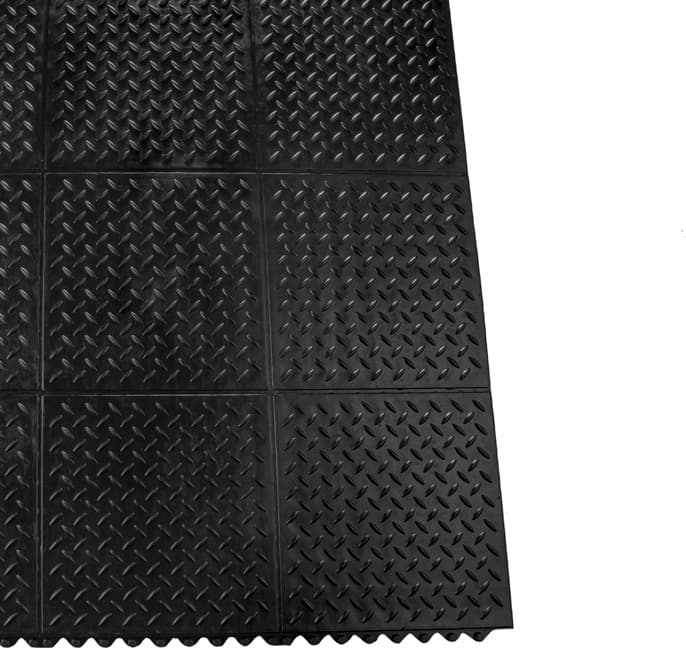
Shield Tech is Highrange’s product example for welding workstation use. It belongs to the Special Purpose catalogue category and is supplied in black at 90 × 90 × 1.4 cm. Its stated application is indoor or outdoor welding workstations.
The listed functions are welding-area floor coverage, welding-workstation coverage and a cushioned standing surface. Highrange describes specialized rubber that helps shield flooring around active welding work, while resilient construction provides cushioning during prolonged standing. These benefits connect the product to the two practical priorities discussed in this guide: covering the intended working area and providing a resilient surface underfoot.
For a purchasing enquiry, compare the listed dimensions with the operator’s standing footprint and explain the floor conditions and surrounding activity. Include how many positions need coverage and whether the mats will stay in place or be moved between uses. This gives the supplier a clear picture of the proposed arrangement.
The product page provides the current specification and enquiry route. Use the terminology guidance above for any additional performance requirement rather than extending the published benefits beyond their stated scope.
Positioning Mats Around a Welding Workstation
Start with stance, tools and controls
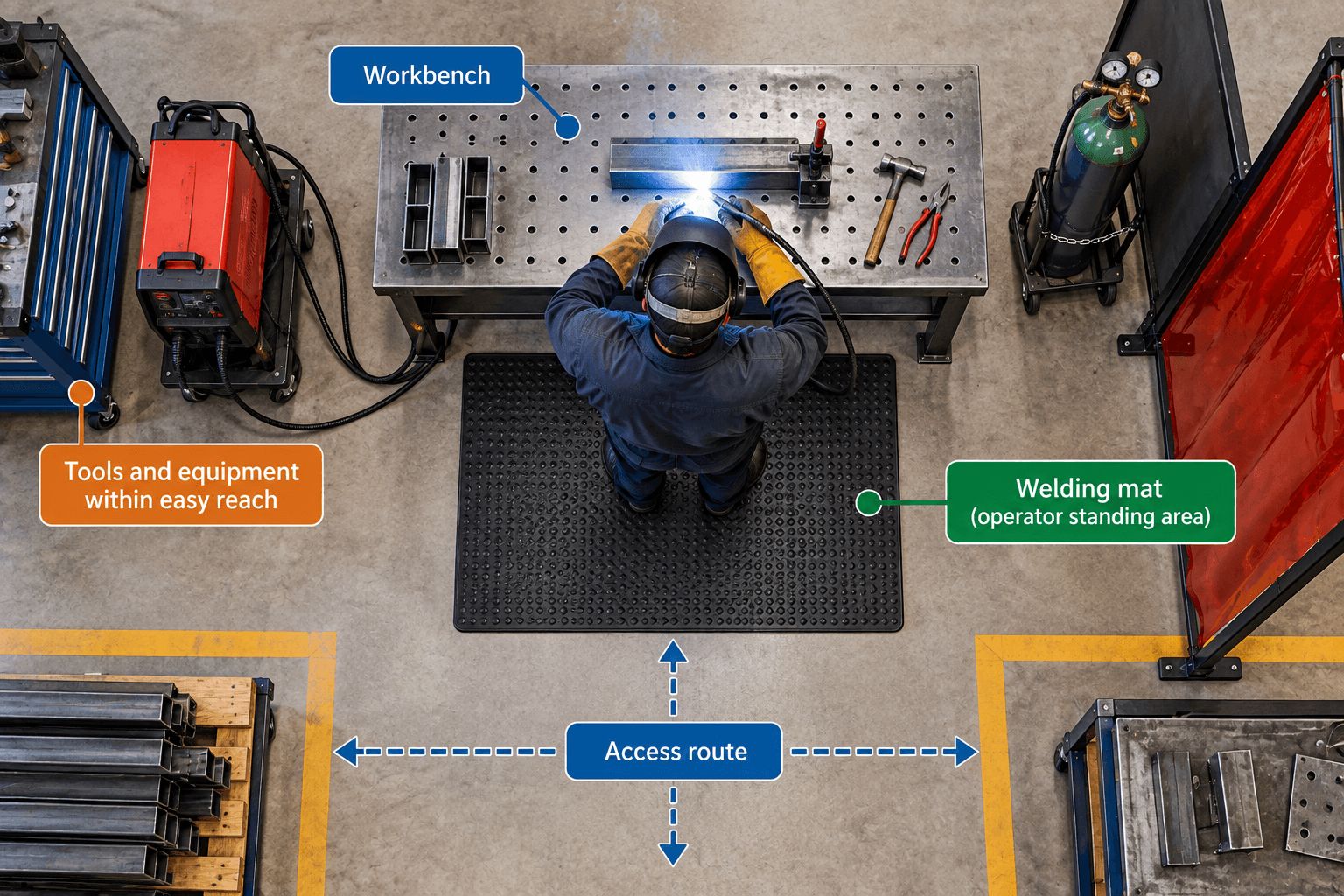
Plan the mat around the normal working position, then check access to frequently used tools and controls. Include preparation and handling movements as well as the welding task itself. A useful layout lets the operator use the covered area naturally, without an awkward reach created by the mat’s position.
Review clearances, edges and transitions
Check the floor arrangement as a whole: equipment clearance, nearby storage, access routes and the points where people step onto the mat. Keep edges flat and transitions practical. Floor defects need attention in their own right; overlapping loose mats or cutting a product without guidance is not a layout solution.
Make housekeeping easy to carry out
Leave a practical way to reach the floor and underside for cleaning and inspection. Consider who will lift or reposition the mat and how it will be returned to the correct place. This is especially useful where several shifts share the workstation or mats are moved between tasks.
Cleaning, Inspection and Replacement
Build cleaning around the actual residues
Use the manufacturer’s guidance for compatible cleaning methods, equipment and drying. Tell the supplier what residues occur at the workstation so the care advice fits the job. Include the floor beneath the mat, not just the visible surface, and plan handling so routine cleaning is manageable.
Check the surface, edges and underside
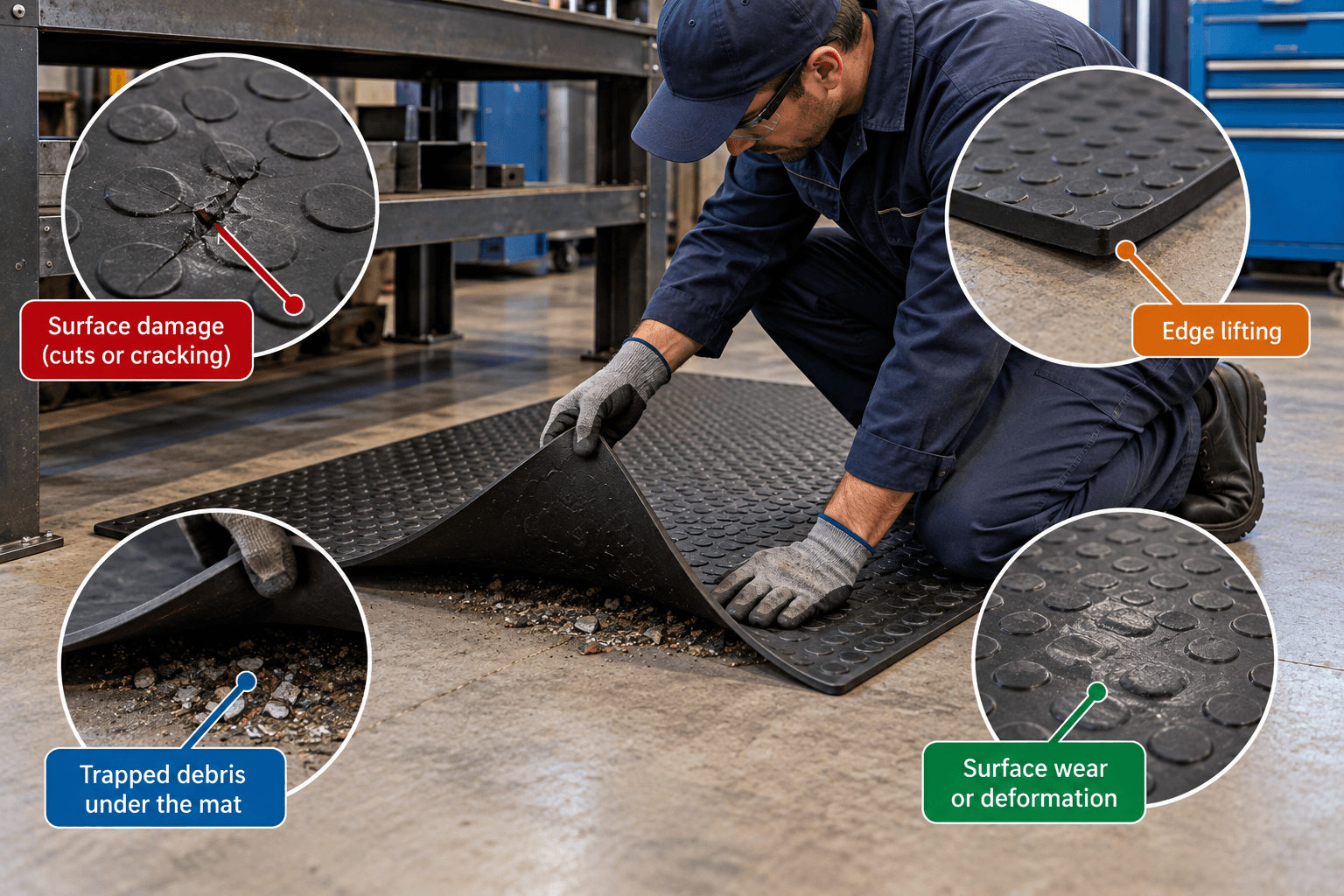
Inspect for cuts, cracking, deformation, lifted edges and changes in the surface. Check beneath the mat for trapped debris and look at the underlying floor. Note any movement from the intended position. Inspection frequency should follow workplace use and procedures, with attention to changes noticed by the operator.
Replace according to condition and suitability
Where damage or instability makes continued use questionable, remove the mat from service through workplace procedures and seek supplier guidance. A damaged mat may no longer provide its stated performance. Replacement is based on condition and suitability, rather than a fixed lifespan for all welding area floor mats.
Revisit the selection when equipment, cleaning products or work processes change. A short record of the reason for replacement can help the next purchase: wear, a changed standing footprint and a new exposure are different problems to solve.
Common Selection Mistakes
A good purchase connects the mat to the way the workstation is actually used. Watch for these common shortcuts:
- Choosing by appearance alone instead of comparing the intended application and finished construction.
- Treating thickness as the whole specification and overlooking the feel, edges and floor transition.
- Measuring only the bench rather than the operator’s stance, movement and access to tools.
- Covering more floor without considering doors, carts and the routes used by other people.
- Making cushioning the only criterion while ignoring stable placement and daily handling.
- Overlooking cleaning, moisture or associated workshop activities when describing the environment.
- Assuming that fire-retardant, electrical or static-control properties belong to every mat in a range.
Welding Workstation Mat Selection Checklist
Use these eight steps to turn the working arrangement into a clear supplier brief. A sketch or photograph of the area can help explain details that are difficult to capture in a product name alone.
- Describe the workstation and tasks, including welding, preparation and associated workshop activity.
- Identify the required functions, such as floor coverage and cushioning during prolonged standing.
- Record the indoor or outdoor environment, floor condition and likely moisture or process residues.
- Measure the operator’s usable standing area and mark tools, equipment, routes and edge transitions.
- Compare available dimensions and construction, including supported joining or edge options where needed.
- List any special performance requirement and obtain the relevant ratings or documentation before selection.
- Agree placement, compatible cleaning and responsibility for inspection with the workplace team.
- Send the supplier the application, environment, required functions, dimensions, quantity and special requirements for review and quotation, together with delivery details.
Frequently Asked Questions
What are weld-resistant mats used for?
They provide floor coverage for the operator’s standing and working area around a welding workstation. Depending on construction, they can also offer cushioning during prolonged standing. Choose the mat around the task, environment and available dimensions.
Can any rubber mat be used at a welding workstation?
No. Choose a product intended for the proposed welding application. An ordinary rubber mat may serve another workshop function, such as drainage or general standing comfort, without being suitable for the welding position.
Does "weld resistant" mean fireproof?
No. It is a broad purchasing term, not a fireproof rating. Neither rubber generally nor a product described for welding-workstation coverage should be treated as fireproof.
Are welding mats automatically heat-resistant or spark-resistant?
No. Check what the particular product has been tested for, including the method, exposure conditions and limitations. The intended workstation use and a tested resistance rating are different pieces of information.
Can a welding workstation mat improve standing comfort?
A resilient mat can provide cushioning during prolonged standing. Choose for a balance of comfort, stable footing and natural movement around the workstation; cushioning is not a guaranteed medical benefit.
How thick should a welding workstation mat be?
There is no universal thickness. Consider the complete construction, standing needs and edge transition. Thickness is not a thermal rating, and Shield Tech’s listed 1.4 cm dimension is not a rule for other welding mats.
What size mat do I need for my welding station?
Measure where the operator stands and moves, including access to tools and controls. Compare that footprint with available sizes and check edges and routes. Use multiple mats only in an arrangement supported by the product.
Can welding workstation mats be used outdoors?
Yes, where the product is intended for outdoor use and suits the location. Shield Tech is listed for indoor or outdoor welding workstations. Describe the ground, shelter and wet conditions when requesting advice.
Is a fire-retardant mat automatically suitable for welding?
No. Fire-retardant performance and welding-workstation suitability are separate requirements. Fire Shield Tech’s stated BFL-S1 testing belongs to that product, not Shield Tech, and does not by itself identify Fire Shield Tech as a welding mat.
Does a rubber welding mat provide electrical insulation or ESD protection?
Not simply because it is rubber or intended for welding. Electrical insulation and ESD control require separately specified products and documentation. Neither is a published Shield Tech benefit.
How should welding workstation mats be cleaned, inspected and replaced?
Follow compatible care guidance and inspect the surface, edges and underside for damage, lifting and trapped debris. Address instability through workplace procedures and supplier advice. Replace according to condition and suitability, including changes to the workstation.
What are Shield Tech's published specifications, and what should I confirm before ordering?
Shield Tech is a black Special Purpose mat measuring 90 × 90 × 1.4 cm for indoor or outdoor welding workstations. It offers stated floor coverage and cushioning benefits. Discuss your standing area, environment, quantity and any additional performance requirements before ordering.