
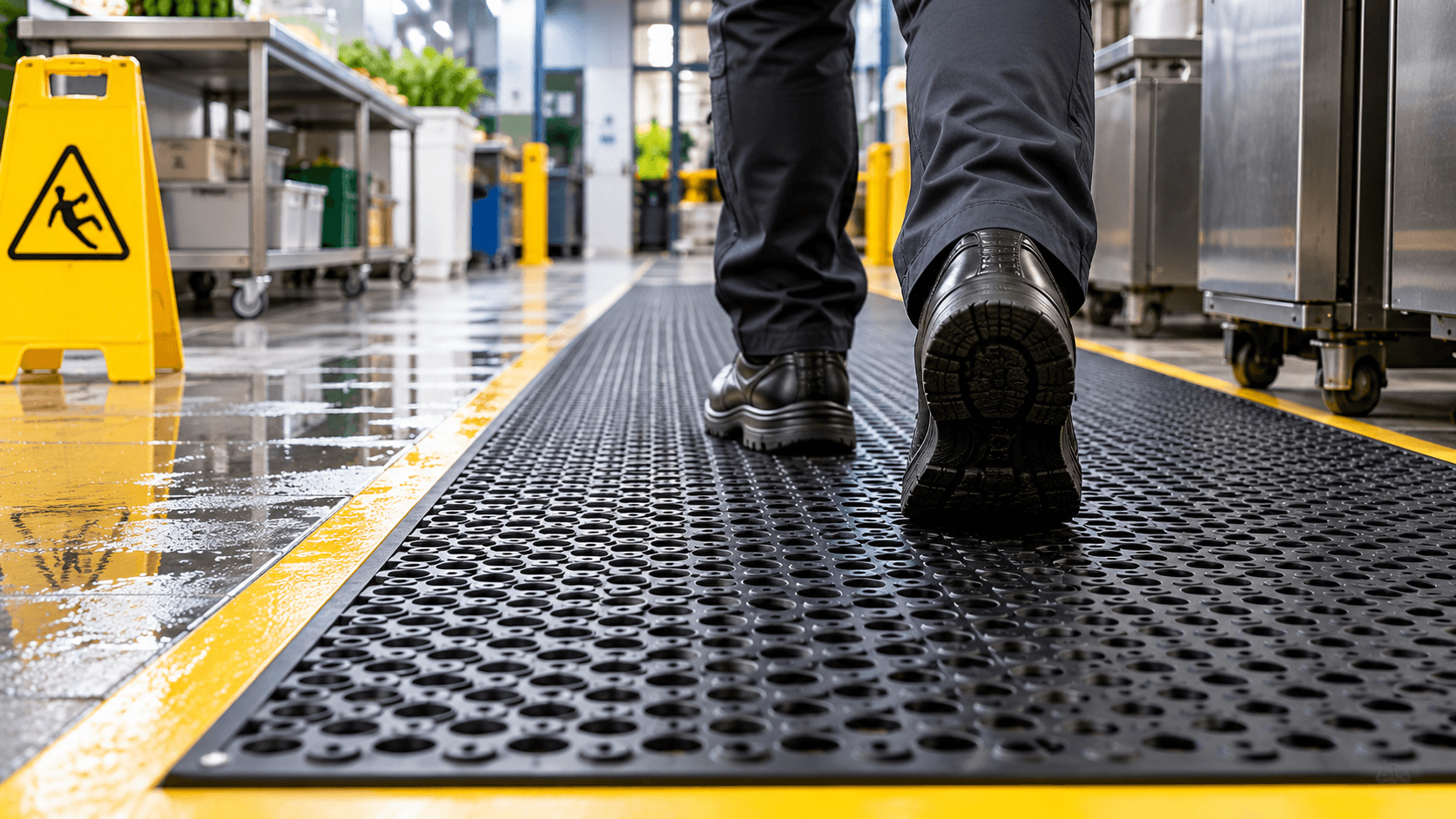
There is no single rubber mat that is ideal for every environment. A commercial entrance, dairy facility, kitchen and factory workstation present different demands. Choosing rubber matting starts with the job and exposure, then moves to the functions, format and published product information that support that use. This guide helps narrow the category before selecting an individual product.
Start with the Job the Mat Must Perform
Begin with where the mat will work, not which one looks best or has the greatest thickness. Is the location indoors or outdoors, dry or wet, oily or greasy? Will people stand on it, walk across it or share the area with equipment or animals? These details establish the problem the mat needs to address.
Identify the required functions separately. Standing comfort, drainage, floor coverage and entrance soil management answer different needs. A cushioned surface does not establish electrical insulation; rubber alone does not provide ESD protection. One product may support several functions, but each needs to appear in its own specification.
Then consider how the area is used and cleaned. A small standing position may suit a defined mat, while a larger zone may need connected tiles or a supported roll format. Keep the proposed function and coverage together as you review options.
Application-to-Requirement Comparison
Use this overview to identify the next category to investigate. The following sections explain the distinctions behind each route.
- Entrance → tracked dirt or moisture → scraping or moisture management → defined mat or runner → entrance selection guide.
- Industrial workstation → standing, fluids or specialist exposure → separately specified functions → mat, modular system or roll → industrial guide.
- Kitchen or wet work area → water, grease and cleaning → drainage, compatible material or standing support → supported workstation or coverage format → kitchen guide.
- Dairy or equine facility → animal activity, moisture and cleaning → flooring for the specific area → supported mat, tile or roll → the relevant animal-flooring guide.
- Gym → activity and equipment → suitable training-area or floor coverage → supported matting or tile system → gym flooring guide.
- Outdoor position → site-specific exposure → the intended function in an approved environment → product-specific format → check the stated outdoor application.
Commercial Entrances and Transition Areas
Entrance selection starts with what is carried through the doorway and how people cross it. Consider tracked-in dirt, moisture, footfall and the transition between outside and inside. Scraping debris, absorbing surface moisture and allowing water to pass through openings are different functions; not every entrance mat offers all three.
Measure the usable entrance area, door clearance and approach. Review the edge profile, surface format and cleaning access alongside appearance. A product for a sheltered internal doorway should not automatically be extended to a fully exposed entrance.
This is a different task from covering a standing workstation. Select for the entrance conditions and the product’s stated role, without treating a textured surface as a guarantee of slip prevention. Highrange’s entrance guide separates scraper, decorative, moisture-management and runner requirements.
Industrial Workstations and Specialist Requirements
When choosing industrial rubber mats, distinguish a dry standing area from a location with recurring oils or other fluids. Define the standing footprint, movement between controls, coverage and cleaning environment. Where cushioning or drainage is needed, confirm that function rather than assuming it from the industrial label.
Surface and edge format should suit the position and surrounding routes. Describe equipment contact or wheeled movement separately; a mat for foot traffic is not automatically suitable for every workshop activity.
Identify specialist requirements separately
Welding-workstation coverage, electrical insulation, ESD control and fire retardancy are distinct requirements. A general industrial mat does not acquire those properties because it is rubber or cushioned. Electrical insulation and ESD control also perform different functions and require appropriately specified products.
For welding positions, begin with intended workstation use and review any additional exposure requirements. The dedicated Weld Resistant Mats guide explains the distinction between floor coverage and tested resistance. Use it for the detailed selection process rather than treating a general workshop mat as a substitute.
Commercial Kitchens and Wet Work Areas
A wet floor and a greasy workstation do not present identical requirements. Identify whether the main issue is water, oils or grease, prolonged standing, cleaning access or a combination. A drainage design does not automatically establish grease or oil resistance. Conversely, grease-resistant material does not establish every other wet-area function.
For a drainage product, consider where liquid goes after passing through the openings and how the underlying floor can be cleaned. For a solid surface, consider how liquids and debris will be managed around it. The floor arrangement and cleaning method remain part of selection.
Work Top Pro is a separate Highrange example with published grease resistance, anti-fatigue cushioning and lightweight construction for indoor food-service use. Those stated properties do not identify its polymer composition as NBR or establish drainage performance. Compare each candidate’s documented functions with the actual kitchen position.
Dairy and Equine Facilities
Animal flooring should be selected for the specific area and activity. Resting, standing and moving locations can need different coverage, surface construction and installation arrangements. Describe moisture, manure exposure, cleaning and the existing floor before choosing dimensions or format.
Dairy areas
Highrange’s dairy guide distinguishes cubicle resting surfaces, cattle-area mats, holding and milking areas, passage flooring and continuous cowpen coverage. These are separate requirements within the same facility. A mat shortlisted for a cubicle should not automatically be specified across a cattle passage.
Check how the selected format fits the area, how adjoining sections are handled where applicable and how cleaning can be carried out. Use the product’s stated location and installation information to narrow the options.
Equine areas
For rubber mats in horse stalls and stables, distinguish connected floor coverage from a defined loose-box or lying-area mat. Highrange also lists stable-wall protection separately; a wall panel should not be treated as a flooring product.
Confirm the horse activity, existing surface, indoor or outdoor placement and supported coverage format. These are practical flooring decisions, not promises of improved animal health, injury prevention or veterinary outcomes.
Gyms and Fitness Areas
Describe the workout zone, equipment and required coverage before selecting rubber mats for gyms. A defined equipment area and a larger training floor raise different layout questions. Thickness is one factor alongside construction, intended use, transitions and maintenance; it does not establish an impact, acoustic or load rating.
Highrange’s listed gym flooring range consists of interlocking tile systems. Check the selected product’s environment and features rather than assuming every tile supports the same position. Use the dedicated Rubber Gym Mats guide for thickness, interlocking formats, equipment-area considerations and detailed selection.
Outdoor Placement and Exposure
“Rubber” alone does not establish outdoor suitability. Check that the product is specified for outdoor use and describe the particular location: shelter, water exposure, substrate, drainage and the function required. A covered entrance and an exposed work position can involve different conditions.
Plan cleaning and placement so the format suits the available surface. An indoor/outdoor designation is useful application information, but does not supply a UV rating, temperature range or freeze-resistance claim. Ask for clarification where the location introduces a requirement not addressed by the published product data.
Choosing Between Mats, Tiles and Rolls
Format follows the layout. These are general coverage considerations, not a statement that every Highrange product is available in all three formats.
Individual mats
Individual mats can suit defined workstations, entrances and localised coverage. Compare their footprint with the usable area and consider handling for cleaning or replacement where supported. Several loose mats do not automatically form an approved continuous floor system.
Interlocking tiles
Tiles can provide modular coverage for larger zones and configurable layouts, with individual sections replaceable where the system permits. Plan the connected area, perimeter and transitions. Confirm the actual tile system and supported installation rather than assuming different products will connect.
Rolls
Rolls can suit longer floor runs, corridors or continuous zones where fewer joins are desirable. Check available widths, handling, fitting and the product’s intended application. A roll format does not itself establish suitability for animal, gym, kitchen or industrial use.
Turning the Application into a Product Shortlist
Use a consistent selection sequence so products are compared against the same need:
- Define the environment and the exact area, including indoor or outdoor placement.
- Identify the principal exposure: dry use, water, oil, grease or other conditions.
- Name each required function, such as drainage, standing support or floor coverage.
- Choose a format that fits the working area and cleaning arrangements.
- Compare documented product applications, environments and relevant properties.
- Check dimensions, edges, installation and the proposed coverage layout.
- Review welding, electrical, ESD or other specialist requirements separately.
- Request an application review if an important requirement remains uncertain.
Compare zones before standardising
For example, a facility may contain a dry packing station, a wash area and an oily maintenance position. Buying one mat for all three simplifies ordering only if its documented functions meet each requirement. Record the differences first, then decide whether a shared product or separate shortlist is appropriate.
A simple area sketch can show standing positions, routes, obstructions and the floor to be covered. Add the exposure and cleaning conditions beside each zone. This keeps the enquiry focused on product suitability rather than a broad request for the thickest or most specialised mat.
Highrange’s application guides provide the next step into sector-specific products. Where the remaining question concerns wear and service conditions, use the durability guide. Review only the information needed to resolve the selection; a broad category name is a starting point, not the final specification.
Frequently Asked Questions
How do I choose the right rubber mat?
Start with the location, exposure and required function, then compare supported formats and product specifications. Check dimensions and cleaning conditions before selecting by appearance or thickness.
What type of rubber mat is best for industrial use?
There is no universal choice. Dry standing positions, wet areas, fluid exposure and specialist work need different functions. Use the industrial guide to narrow the category before reviewing products.
What is the difference between a drainage mat and a solid rubber mat?
A drainage design provides openings or a stated path for liquid management; a solid surface does not offer the same open format. Neither description establishes oil resistance or universal wet-area suitability.
Are rubber mats suitable for wet areas?
Some products are intended for wet locations. Check drainage, material compatibility, the underlying floor and cleaning arrangements together. The fact that a mat is rubber is not sufficient evidence.
Can the same rubber mat be used indoors and outdoors?
Only where the particular product supports both environments and suits the actual placement. Confirm the proposed exposure rather than extending an indoor application outdoors.
Should I choose individual mats, interlocking tiles or rolls?
Choose by the coverage layout and supported installation. Individual mats suit defined positions, tiles offer modular coverage, and rolls may suit longer runs. Available formats depend on the product.
Can a general industrial rubber mat be used for welding?
Do not assume so. Select for the stated welding-workstation application and review any additional requirements. The specialist welding guide explains coverage and performance distinctions.
Are all rubber mats oil resistant?
No. Check the named product’s published properties against the actual exposure. Drainage, cushioning or an industrial application label does not establish oil resistance.