
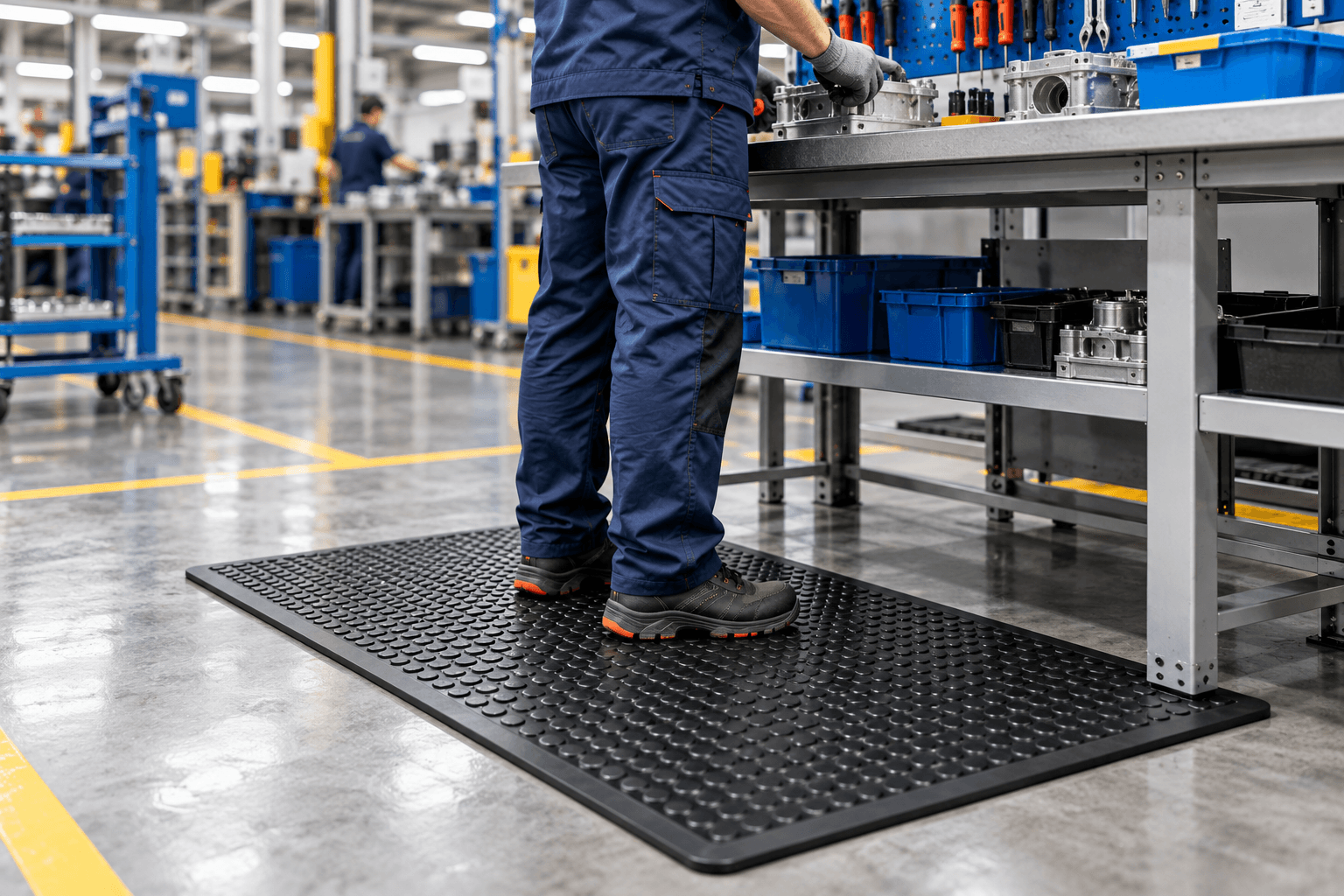
Choosing anti-fatigue rubber mats begins with the work being done, not a preferred surface pattern. A person standing at one inspection bench, an operator moving between controls and staff working around kitchen spills have different requirements. The useful starting point is the standing area, its conditions and the functions the mat must provide.
This guide helps buyers compare documented support, coverage and exposure requirements before requesting a quotation. It uses Highrange product examples while distinguishing explicit anti-fatigue descriptions from modular flooring, drainage and specialist workplace functions.
What Are Anti-Fatigue Rubber Mats?
Anti-fatigue mats provide a resilient standing surface where comfort during extended standing is a selection concern. The term should describe a documented product function. Being made of rubber, having a textured face or being sold for a factory floor does not by itself establish anti-fatigue support.
Highrange explicitly describes Work Easy and Work Top Pro as anti-fatigue products for their respective applications. Other workstation mats may provide connected coverage, grip or drainage without that designation. Treat comfort as one part of the purchasing brief, alongside compatibility with the location and task. The published support descriptions are not medical promises or quantified ergonomic results.
Start with the Standing Task and Workstation
Describe a normal shift at the proposed position. Record how long staff stand there, whether they turn or step between tasks, and where their feet move when reaching controls, checking parts or handling materials. A drawing of the bench alone can miss the actual standing footprint.
Separate a defined operator position from a longer working zone. An individual mat may cover one station; connected coverage may be relevant where movement extends along a bench. Mark equipment feet, storage, access routes and any carts passing nearby. For several stations, record differences in task and conditions rather than assuming one specification suits all of them.
Worker comfort should be discussed with the complete workstation requirement. A mat recommendation needs to account for how the area is used, not just the amount of floor available.
Check Floor Conditions and Workplace Exposure
Identify indoor or outdoor placement and describe the existing floor, including uneven areas, moisture and residues. Record whether the location normally stays dry or receives spills. The four main product examples below are listed for indoor use; their presence in a workstation guide does not extend them to outdoor locations.
Name oils, grease, process fluids and cleaning products separately. Describe whether contact is occasional or recurring and whether liquid can remain beneath the mat. Cushioning and environmental compatibility are different questions: a comfortable standing surface still needs to suit the exposure.
For example, Work Top Pro has a published food-service grease-resistance role. That does not establish compatibility with every industrial lubricant or cleaner. Ask for confirmation against the actual substances and conditions before treating a candidate as suitable.
Compare Cushioning, Construction and Surface Design
Look for an explanation of the finished construction and its stated function. Work Easy uses a raised bubble-top surface and resilient support; its published description says raised cushioning distributes standing pressure. This is a specific product example, not proof that every raised pattern provides the same support.
A textured surface can serve a different purpose. Work Sure has a diamond-top standing surface with grip and connected workstation coverage, but its published description does not establish cushioning. Similarly, modular edges describe how coverage is assembled, not how the surface feels during a shift.
Avoid ranking products by apparent softness or thickness alone. Compare the documented role with the task, and identify any required property that needs further confirmation.
Choose the Right Coverage: Mats, Tiles and Rolls
Individual mats provide a defined footprint for a workstation. Modular tiles connect to cover a larger area, while rolls can suit longer continuous zones. Choose the format around movement and coverage, then verify the required functions for that particular product.
Do not assume a roll is an extended version of an anti-fatigue mat. Dome Max, for example, is described for continuous coverage and bevelled edges that ease wheeled movement; those features do not establish anti-fatigue performance. Likewise, a connected kitchen drainage tile should retain its stated application rather than becoming general industrial flooring simply because it connects.
Include handling and access for upkeep in the layout discussion, especially where the floor beneath needs to remain reachable.
Confirm Size, Thickness and Edge Transitions
Measure the area used for standing, turning and moving between tasks, then compare it with the published mat or tile dimensions. Check the units and size order. Record door clearances, aisle boundaries, equipment positions and transitions to the surrounding floor.
Work Easy and Work Top Pro do not publish thickness in the current product records. Ask for the required specification rather than estimating from an image or borrowing a dimension from another product. Work Easy and Work Sure list custom-size options, which still need confirmation for the proposed requirement.
There is no universal best thickness established here. Review thickness with construction, placement and movement across edges. If carts cross the area, describe that separately; support for standing does not automatically establish suitability for wheeled traffic.
Treat Grip, Drainage and Resistance as Separate Requirements
Write each required function into the brief. Cushioning concerns standing support. Surface grip concerns footing under the relevant conditions. Drainage concerns where liquid moves. Oil resistance, grease resistance and compatibility with other chemicals concern specific exposures. Evidence for one does not establish the others.
Work Link Pro explicitly combines kitchen drainage with cushioned workstation comfort, but it has no published grease-resistance claim. Work Top Pro has grease resistance and anti-fatigue cushioning, but its current data does not establish drainage. Neither description is a universal chemical-compatibility statement.
For industrial oil exposure, Guard Tech has its own documented oil/fluid role and selectable NBR content. Those properties do not transfer to Work Easy. Review grip alongside contaminants, footwear, cleaning and installation; neither texture nor drainage guarantees slip prevention. Also confirm how spills will be managed beneath and around the selected coverage.
Compare Highrange Workstation Mat Options
These four examples answer different selection questions. Use their published applications and functions to build a shortlist, then open the product pages for the complete information. They are not ranked as universally better alternatives.
Work Easy — HR-037: industrial anti-fatigue support
Work Easy is an indoor Industrial mat in the Special Purpose category. Its published material is “Special synthetic blend”. The raised bubble-top surface provides cushioning, with explicit “Anti-fatigue support” and wording that resilient material helps reduce strain during long shifts.
Listed sizes are 60 × 90 cm, 90 × 120 cm and Custom size. It is the principal industrial anti-fatigue example here. Thickness, drainage and oil, grease or chemical resistance are not published in its current record; do not assume them from its industrial application.
Work Sure — HR-038: modular industrial standing coverage
Work Sure is an indoor Industrial tile in Special Purpose. Its diamond-top textured surface and connected sections provide workstation coverage, with close-fitting edges forming a nearly seamless area. Listed sizes are 30 × 80 cm, 70 × 80 cm and Custom size.
It is not explicitly described as anti-fatigue and has no published cushioning claim. Consider its modular coverage role separately from the standing-support requirement.
Work Top Pro — HR-034: food-service anti-fatigue cushioning
Work Top Pro is an indoor Food Service mat for Restaurant & kitchen applications. Its lightweight top-deck construction combines published grease resistance, anti-fatigue cushioning and easy-to-clean wording. Listed sizes are 60 × 90 cm and 90 × 150 cm.
Use it as a food-service comparison, not a default industrial recommendation. The overview describes grease-resistant rubber, but does not identify the polymer composition. Thickness and general oil or chemical resistance are not established.
Work Link Pro — HR-035: kitchen drainage and comfort
Work Link Pro is an indoor Food Service tile for Restaurant & kitchen working zones. Modular tiles connect rapidly; drainage moves spills away from underfoot, and cushioned rubber supports staff through extended shifts.
Listed sizes are 90 × 90 × 1.2 cm, 90 × 90 × 1.4 cm and 90 × 90 × 1.6 cm. Its workstation-comfort wording does not explicitly designate it as anti-fatigue. No oil, grease or chemical-resistance claim is published.
Recognise When a Specialist Mat Is Required
Escalate specialist requirements before choosing on comfort alone. Shield Tech has welding-workstation and prolonged-standing cushioning wording, but is not explicitly designated anti-fatigue. Its intended use does not establish thermal or spark ratings. Fire-retardant requirements are also separate.
Electra Tech serves conductive ESD charge control; Work Insular and Work Hawk have electrical-insulation roles. These functions are not interchangeable and do not belong to ordinary anti-fatigue matting. For oil-exposed areas, review the actual fluid against Guard Tech’s documented scope. Use the relevant product information and specialist guidance to resolve the requirement.
Plan Positioning, Cleaning and Inspection
Plan coverage so it remains available throughout the intended movement area without obstructing access. Confirm a suitable floor and supported fitting arrangement. Check placement, connecting edges where present and transitions before use, and resolve movement or unevenness rather than treating it as an unavoidable feature.
Make the surface and floor beneath accessible for maintenance where relevant. Follow compatible product cleaning instructions; the catalogue does not establish one cleaner, temperature, pressure or schedule for this range. Work Top Pro’s easy-clean description does not supply a detailed cleaning procedure.
Inspect the physical condition and placement, including worn surfaces, damaged edges, trapped debris and changes around equipment. If the task, fluid exposure or floor layout changes, review whether the original selection still fits.
Evaluate Durability Without Assuming a Service Life
Durability depends on the combination of construction, actual use, exposure, placement and maintenance. Work Easy’s industrial-durability wording is qualitative; it does not establish a lifespan or warranty. A mat that suits one station may face different wear at another.
Base replacement discussions on condition and continued suitability. Record damage, changes in surface or fit, and any new operating requirement. For repeat purchases, compare the same product and specification rather than relying on a similar colour or pattern. The durability guide explains these factors in more detail.
Prepare a Workstation Mat Enquiry
Send one brief for each materially different workstation. Separate essential requirements from preferences and identify missing specifications so the response can address them before quotation.
- Application, task, standing duration and movement area.
- Measured coverage, existing floor, doors, aisles and wheeled access.
- Indoor or outdoor location, dry or wet conditions and drainage needs.
- Named oils, grease, process fluids and cleaning exposure.
- Any welding, electrical-insulation or ESD requirement.
- Preferred product or format, custom-size requirements where relevant, quantity and destination.
Frequently Asked Questions
How do I choose an anti-fatigue mat for a standing workstation?
Define the task, standing and movement footprint, floor conditions and exposure. Compare the required support with documented product functions, then confirm dimensions, placement and care requirements. Share unresolved specifications with the supplier before ordering.
Are all rubber workstation mats anti-fatigue?
No. Rubber workstation products can serve grip, drainage, floor coverage or specialist functions without an explicit anti-fatigue designation. Work Sure provides modular standing coverage, while Work Link Pro describes kitchen drainage and comfort; neither is explicitly labelled anti-fatigue.
Which Highrange products are explicitly described as anti-fatigue?
Work Easy is the industrial example with explicit anti-fatigue support. Work Top Pro provides anti-fatigue cushioning in its food-service role. Both are listed for indoor use; their claims should not be transferred to other products or applications.
What thickness should an anti-fatigue mat be?
There is no universal best thickness established by the catalogue. Compare construction, task, dimensions and edge transitions. Work Easy and Work Top Pro do not publish thickness in their current records, so request that specification rather than estimating it.
Can anti-fatigue mats be used around oil or grease?
Only when the selected product supports the actual exposure. Work Top Pro has food-service grease-resistance wording; Work Easy has no published oil or grease-resistance claim. Guard Tech’s separate industrial oil/fluid role does not establish anti-fatigue support.
Should I choose an individual mat or modular tiles?
Match coverage to the measured standing and movement area. An individual mat can cover a defined station; connected tiles can cover a wider zone. Check the selected product’s application and support claims separately, because format does not establish anti-fatigue performance.
How should workstation mats be cleaned and checked?
Follow compatible product instructions and maintain access to the floor beneath where relevant. Check surfaces, edges, connections and stable placement. No universal cleaner, wash setting or cleaning interval is published for these products; request the appropriate care guidance.
Can a general anti-fatigue mat be used at welding or electrical stations?
Do not assume suitability. Welding coverage, electrical insulation and ESD charge control are separate requirements needing appropriate product evidence. Cushioning alone establishes none of them. Identify the workstation conditions and review the relevant specialist product or guide before selection.