
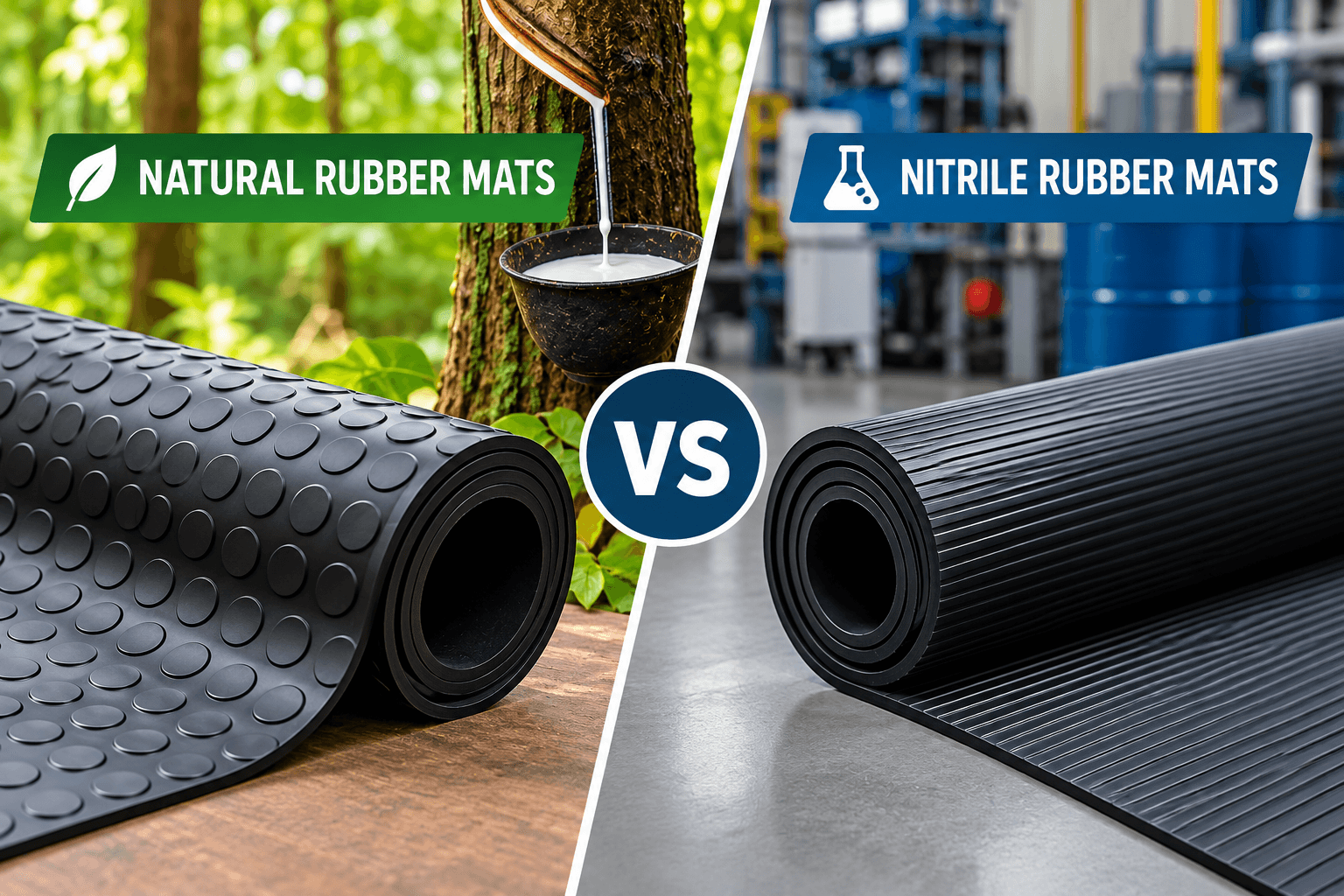
Two rubber mats may look similar but respond differently to oils, grease, cleaning agents and everyday use. Choosing between natural rubber and nitrile rubber mats starts with the conditions the finished product must handle. This guide explains the material differences, why compound formulation matters and how to compare published specifications without assuming one rubber is best for every workplace.
Natural Rubber and Nitrile Rubber: The Essential Difference
Natural rubber and nitrile rubber are different elastomer families: materials that can deform and recover. Natural rubber is valued for resilience and flexibility; nitrile, commonly called NBR, is often considered where oil resistance is an important requirement. Those characteristics are starting points for comparison, not complete mat specifications.
The useful question is what the mat will encounter. A dry entrance and an oil-exposed workstation may need different compounds even when their mats have similar dimensions. Material choice should follow the operating environment, with the finished product checked for the intended role.
Natural rubber vs synthetic rubber is a broader comparison than natural rubber vs NBR. Nitrile is one synthetic rubber family, not a name for every synthetic compound. Another formulation may be appropriate when neither shortlisted option has documented suitability for the requirement.
Natural Rubber Properties Relevant to Matting
Natural rubber properties such as elasticity, resilience and flexibility are useful in products that bend or provide a yielding surface. In matting, these characteristics can contribute to underfoot feel and the way the product responds during use. The compound and physical construction determine how those properties appear in the finished mat.
Natural rubber mats may therefore suit general-purpose commercial environments where the selected product supports the traffic, placement and maintenance conditions. An entrance without significant oil exposure is a different material-selection problem from a maintenance bay with recurring fluid contact.
Do not reject natural rubber simply because a location is industrial. A dry work area may have no need for an oil-resistant rubber material. Equally, general-purpose suitability is not evidence of resistance to a particular oil, cleaning chemical or outdoor exposure. Check the individual specification rather than extending the material’s general characteristics into unsupported ratings.
Nitrile/NBR Properties Relevant to Matting
NBR stands for nitrile butadiene rubber. Nitrile rubber properties make suitably formulated compounds useful where oils, greases and certain fluids are present. Buyers often consider nitrile rubber mats for exposed industrial positions, but the fluid and conditions still need to match the product’s supported use.
Resistance to swelling or degradation is a property to assess for the actual formulation and exposure. A brief splash and repeated contact with standing liquid are different requirements. Cleaning agents can introduce another exposure even when the operating fluid remains unchanged.
The description “NBR rubber mat” does not establish resistance to every oil, solvent, fuel or chemical. Nor does it supply temperature limits or a slip rating. Use the material designation to identify candidates, then review the finished product’s stated properties and any documentation needed for the job.
Natural Rubber vs Nitrile: A Practical Comparison
The better material depends on the exposure and performance requirement. Compare products against the same conditions rather than treating NBR vs natural rubber as a universal ranking.
- General-purpose use: a suitable natural-rubber compound may meet the requirement where flexibility and resilience matter and oil exposure is limited. A nitrile designation alone does not make another mat more suitable.
- Oils and grease: NBR compounds are commonly considered for these exposures. Confirm the specific fluid and product claim instead of assuming all natural-rubber or nitrile mats behave alike.
- Other fluids: neither material name supplies a complete compatibility list. Identify process fluids and cleaners separately, including mixtures used at the workstation.
- Resilience and flexibility: both the compound and construction affect feel and movement. A photograph, colour or thickness measurement cannot establish the material’s quality.
- Environment: verify indoor or outdoor suitability for the finished product. The polymer family alone does not approve a particular location.
- Buyer evidence: compare the named product, stated property and relevant conditions. Ask what an unfamiliar material designation means before treating it as a performance measure.
Why Compound Formulation Changes the Answer
A polymer family identifies the base material; a rubber compound is a formulation prepared to achieve particular processing and finished-product characteristics. It may include a base elastomer or blend, fillers, a curing system, processing aids and other ingredients. Their functions differ, so a compound is more than a single material percentage.
Two products described as nitrile rubber can consequently have different finished performance. The same applies to two natural-rubber products. Differences in formulation and construction mean that one product’s published result cannot automatically be applied to another, even when both share a broad material label.
For purchasing, distinguish the material description from the property you need verified. “Contains NBR” identifies something about composition; “intended for this fluid exposure” addresses the application. Neither should be substituted for the other. Request clarification where a specification names a compound but does not explain its intended operating conditions.
Evaluating Oils, Fluids and Cleaning Exposure
“Oil resistant” should not be read as resistance to every industrial fluid. Give the supplier the actual fluid or product name where available, rather than describing the area only as “oily”. Include cleaning products because they may contact the mat more often than the process fluid.
For example, a workstation may encounter occasional lubricant drips during a shift and a diluted cleaner every evening. Record both exposures, including whether liquid collects underneath. A recommendation based only on the lubricant would leave part of the operating conditions unaddressed. If either product changes, the material review may need updating. Keep the fluid names and cleaning instructions with the mat specification so a repeat purchase can be checked against the same conditions.
- Identify the oil, grease or fluid and any mixture or dilution used. Share available product information when the composition is unclear.
- Describe occasional splashes, repeated wetting or pooling liquid, including how long contact normally lasts before cleaning.
- List cleaning agents, frequency and method, including rinsing and drying arrangements.
- Record indoor or outdoor placement and relevant operating conditions, including unusual temperature exposure that needs separate review.
- Explain drainage needs, surface format and the surrounding floor. Liquid beneath a mat also matters when assessing the proposed use.
Matching Material to the Application
These examples show how exposure changes the material question. They are selection scenarios, not blanket approvals for a rubber family.
A general commercial entrance
Where significant oil exposure is absent, start with a product suited to the entrance conditions. A natural-rubber option may be appropriate, but outdoor exposure and cleaning still need review. There is little value in specifying nitrile solely because it sounds more specialised.
An industrial workstation with recurring fluids
Identify the fluids and contact pattern, then shortlist products with relevant oil/fluid-resistance claims. An NBR option may be worth reviewing. If several fluids occur, provide all of them; suitability for one does not settle the full requirement.
A food-service area with grease
Look for a published grease-resistance claim appropriate to the location and discuss the cleaning regime. A product can state that function without publishing its polymer composition. Do not infer nitrile content from grease-resistance wording or from the mat’s colour.
A location with several requirements
Where fluid exposure, drainage and standing comfort all matter, assess each function separately. Drainage holes do not establish chemical resistance, and a compatible compound does not establish every other required property. If evidence is incomplete, seek another supported formulation or product.
Highrange Product Examples and Published Specifications
These examples illustrate why buyers should use the actual product specification rather than infer composition from an application or appearance.
Guard Tech: published NBR options
Guard Tech is an oil-resistant industrial mat with published options of 50%, 80% or 100% NBR. Highrange describes specialized rubber designed to resist swelling around oil and other fluid exposures. The product is listed for indoor or outdoor industrial use, in black, at 90 × 150 cm with a custom-size option.
These are the published NBR options. The available product data does not define the percentage measurement basis. Do not interpret them as acrylonitrile percentage, chemical concentration, purity, an oil-resistance percentage or a performance rating. A higher stated option does not automatically establish better performance for every application; the proposed exposure still needs review.
Work Top Pro: a separate grease-resistant example
Work Top Pro is an indoor food-service mat with stated grease resistance, anti-fatigue cushioning and lightweight construction. Its listed sizes are 60 × 90 cm and 90 × 150 cm. Those details support a discussion about kitchen exposure and handling, but the published data does not identify it as an NBR product.
What to Ask Before Specifying a Rubber Compound
Use a short material-review checklist to resolve uncertainties before bulk purchasing:
- What fluids contact the mat, how often, and for how long?
- What cleaners and cleaning methods will it encounter?
- What environment, drainage, dimensions and format must the finished product support?
- Which published specification supports the required property, and what limitations apply?
- Are other performance requirements separate from material compatibility?
- Would a supplier review or sample assessment help resolve fit or handling questions? A sample’s appearance alone cannot verify chemical resistance.
Prepare the material review
When comparing nitrile rubber mat suppliers in India or elsewhere, provide the same exposure information to each. Share the intended application, actual oils or fluids, cleaning conditions, required dimensions or format and quantity. Highrange can then review a product/material option against the requirement rather than a broad request for “the best rubber”.
Frequently Asked Questions
What is the difference between natural rubber and nitrile rubber?
They are different elastomer families. Natural rubber is valued for resilience and flexibility; nitrile/NBR is commonly considered for oil-related exposure. The finished compound and product determine suitability.
Is nitrile rubber better than natural rubber for mats?
Not universally. Nitrile may be relevant where oil resistance is required, while a suitable natural-rubber product may meet a general-purpose requirement. Compare the actual conditions and specification.
Is nitrile rubber resistant to oil?
Suitably formulated NBR products can offer oil resistance. Confirm the particular oil, contact conditions and product limits; the NBR name does not establish resistance to every fluid.
Are all rubber mats oil resistant?
No. Do not assume oil resistance for a natural-rubber mat or any other mat without supporting product information. Rubber appearance and texture do not establish compatibility.
Is NBR the same as nitrile rubber?
NBR is the abbreviation for nitrile butadiene rubber, commonly called nitrile rubber. It identifies a material family rather than a complete mat specification.
Does a higher NBR percentage automatically mean a better mat?
No. First establish what the percentage describes, then evaluate the finished product for the exposure. Guard Tech’s published NBR options are not numerical oil-resistance ratings.
Can natural rubber mats be used in industrial environments?
Yes, where the individual product supports the conditions. An industrial location does not automatically require nitrile; actual fluid exposure and other operating requirements guide selection.
Does colour tell me whether a mat contains nitrile rubber?
No. Colour is not a reliable composition indicator. Use the named product specification or ask the supplier to clarify the compound.