
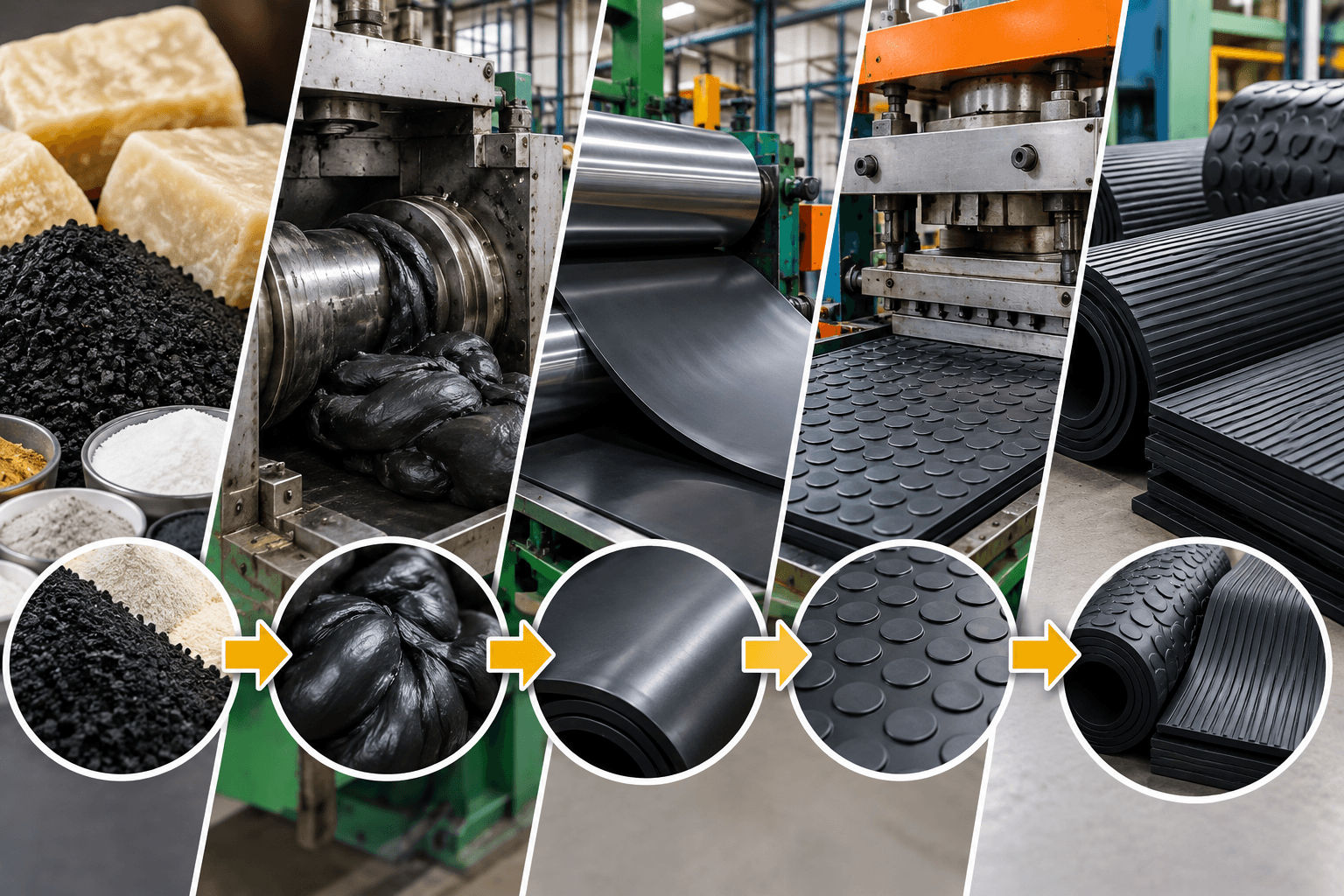
A finished rubber mat may appear simple, but producing it consistently connects material formulation, mixing, moulding, curing and finishing. Manufacturing begins before rubber enters a mould: it starts with what the product must do. This guide follows the manufacture of moulded rubber mats and explains the decisions buyers should understand when comparing finished products.
The Rubber Mat Manufacturing Process at a Glance
For moulded rubber mats, the broad sequence runs from specification to a prepared compound, then through shaping, curing and finishing to inspection and packing. Each stage supplies something the next stage depends on. A clearly defined shape cannot compensate for an unsuitable compound, and a suitable compound still needs controlled processing.
- Define the application and finished-product specification.
- Select the formulation, mix the ingredients and prepare material for moulding.
- Use tooling to form the shape and surface, with curing appropriate to the compound and product.
- Demould, finish, inspect and prepare the product for packing and dispatch.
The scope of this process guide
This is a general explanation, not a factory operating procedure. Production routes vary with format, compound, dimensions, surface design and construction. Rubber rolls, backed mats and composite products should not be assumed to follow exactly the same route as a moulded mat. The Highrange-specific information appears separately below.
Translating the Application into a Product Specification
An entrance scraper mat and a mat intended for recurring oil exposure may require different formulations and surface designs. Manufacturing therefore starts with a description of the working environment and the functions expected of the finished product. That description becomes a specification against which production can be planned and reviewed.
Useful inputs include length, width, thickness, surface and underside design, edges, colour, product format and relevant exposure. Identify indoor or outdoor placement and any property that needs supporting documentation. Packaging requirements can also affect how the finished product is handled after production.
For example, an interlocking edge introduces a connection requirement as well as an outline dimension. A patterned surface requires more definition than “textured rubber”. Clear descriptions help distinguish intentional design differences from unwanted production variation. They also establish which details need clarification before material and tooling decisions are made.
Compound Preparation and Mixing
Rubber compounding and rubber mixing are connected tasks, but they describe different aspects of preparing the material.
Selecting the formulation
A base polymer identifies the rubber family. A finished compound combines that elastomer, or a blend, with ingredients selected for processing and product requirements. These may include fillers, a curing system, processing aids and other formulation ingredients. The purpose is to produce a material that can be manufactured into the required product.
The formulation influences how the material behaves during production as well as the characteristics of the cured mat. Two products sharing a broad rubber-family description need not use the same compound. Material selection therefore requires more information than colour or appearance; proprietary recipes are not needed to ask what the finished product is specified to do.
Distributing ingredients consistently
Mixing incorporates the ingredients into the rubber and distributes them appropriately. The aim is material that behaves consistently during later preparation, shaping and curing. Controlling ingredient quantities and the mixing process helps reduce variation that could otherwise carry through to the finished product.
The equipment and sequence depend on the compound and production route. A buyer need not prescribe a mixer or operating setting, but should understand that formulation and mixing are both part of consistency. Repeating a product specification involves more than reproducing its surface pattern.
Preparing Material and Tooling
Before moulding, mixed material is prepared in a form and quantity suitable for the process. In a compression-moulding example, a measured amount of compound, often called a charge, is placed into the mould. The quantity and distribution need to suit the cavity and product geometry.
Too little material can leave the shape incompletely filled; excess material can contribute to flash, the thin excess rubber that forms beyond the intended product boundary. Charge preparation is therefore part of process control, rather than simply filling a mould by eye.
Tooling defines the intended geometry and needs to be suitable for forming it repeatedly. Relevant features can include the surface pattern, underside, perimeter and connecting edges. These are general principles: the required preparation, equipment, tool construction and dimensional allowances depend on the selected manufacturing route, not a universal procedure for all rubber mats.
Moulding the Shape, Surface and Edges
Moulding gives the compound the physical form of the mat. In a moulded process, the material fills tooling that defines features such as overall shape, thickness profile, raised areas, recesses and edges. Heat and pressure are used as appropriate to the forming and curing process.
Surface geometry can be functional as well as decorative. A scraper pattern, a drainage opening and an interlocking connection address different design objectives. Where included in the design, the underside or moulded identification details also form part of the finished geometry.
A visible pattern does not itself establish a slip rating, drainage performance or cushioning value. Buyers should compare the actual published product specification. Likewise, similar-looking mats may differ in compound or construction. Rubber moulding explains how a shape is produced; it does not establish every performance claim associated with that shape.
Vulcanisation and Curing Control
Vulcanisation is the curing process that develops cross-links within the rubber structure. In accessible terms, these links connect polymer chains into a network, helping turn the uncured compound into a stable elastomeric product with the intended elastic behaviour.
Moulding and curing can take place together, although they describe different functions: shaping the material and developing its cured structure. Rubber curing is not simply drying a wet product. The formulation and process determine how the structure develops.
Time, temperature and pressure must suit the compound, geometry and production method. There is no single cure cycle that can be applied to every mat. Changing the construction or formulation may require different processing conditions; those conditions should be established for the product rather than inferred from another mat’s dimensions.
For buyers, the useful point is the connection between cure control and repeatable finished characteristics. A surface that looks correctly formed is not, by itself, evidence of a particular cure state or independently tested performance. This guide does not prescribe operating parameters.
Demoulding, Finishing and Visual Review
After curing, the product is removed from the mould. Handling and any cooling arrangements need to suit the product and process so the formed surface and edges are not damaged. The precise sequence varies with the manufacturing method.
Finishing may include trimming flash, tidying edges or other operations needed to achieve the intended commercial form. Finishing should preserve the designed geometry, especially where edges connect or meet adjacent surfaces.
A visual review can examine surface formation, edge condition and obvious defects. Dimensional review may also be relevant to the specification. These observations are useful, but they do not replace evidence for a separately required material or performance property. An attractive finish and conformity to a technical requirement are related purchasing considerations, not identical checks.
Quality Checks and Manufacturing Consistency
Rubber mat quality control concerns conformity to the relevant specification and consistency across production. “Premium”, “heavy duty” and “industrial grade” do not define acceptance criteria. Buyers need to know which dimensions, design features and properties are actually being offered.
Depending on the product, review may cover length, width, thickness, surface formation, edges and visible defects. Compound and process consistency also matter because the finished product combines material and geometry. Any additional testing, tolerance or inspection arrangement should be confirmed for the requirement.
- Compound preparation → an appropriate formulation. Buyer question: which published material or property information supports the intended use?
- Moulding → the specified shape and features. Buyer question: which dimensions, patterns and edge options are available?
- Quality review → conformity to the requirement. Buyer question: what acceptance criteria need to be documented or agreed?
Compare like-for-like requirements
For a repeat order, identify the product and specification being compared. A change in size, compound or design is not necessarily a quality defect, but it should not be mistaken for an equivalent specification. Manufacturing consistency supports useful comparisons; it does not supply a universal service-life guarantee.
Packing and Preparing Rubber Mats for Dispatch
Manufacturing does not necessarily end at demoulding. Finished products still need identification, quantity review and packing appropriate to their format and handling requirements. Dimensions, weight and surface features can influence the practical arrangement.
Packing should help preserve the finished product during handling and make the order identifiable. The agreed arrangement depends on the product and supply requirement; there is no single packing specification implied by the term “rubber mat”. Where branding, custom development or programme-specific packing enters the discussion, the OEM guide covers the wider buyer brief.
Highrange’s Published Manufacturing Capabilities
Highrange Rubber & Coir Products Pvt. Ltd. manufactures in Changanacherry, Kerala, India, with manufacturing experience since 1978. Its published manufacturing information describes in-house rubber compound preparation and quality control connected with finished-product manufacturing. The production overview includes moulding, curing and finishing.
Highrange publishes capacity of nearly 24,000 kg of rubber compounds per day. This figure describes compound capacity, not finished-mat output, daily shipments or guaranteed available capacity.
These documented capabilities provide company context for the general rubber mat production process described above. They do not establish particular machinery, cure settings, inspection frequencies or product-specific test results. Readers evaluating rubber mat manufacturing in India can use the manufacturing page for the company overview and the product catalogue for individual specifications.
Frequently Asked Questions
How are rubber mats manufactured?
Moulded mats generally progress from a product specification through compound preparation, mixing, material preparation, moulding and curing, followed by finishing, inspection and packing. The details depend on the product and process.
What is rubber compounding?
It is the preparation of a formulation using a base elastomer and other ingredients selected for processing and finished-product requirements. A compound is more than the name of its rubber family.
What is the difference between rubber mixing and vulcanisation?
Mixing incorporates and distributes ingredients. Vulcanisation develops the cured rubber structure. Consistency in both contributes to the finished product, but they perform different jobs.
What does vulcanisation do to rubber?
It develops cross-links between polymer chains, helping create the stable elastic structure of the cured product. The appropriate curing conditions depend on the compound and manufacturing route.
How are patterns formed on rubber mats?
For moulded mats, tooling defines the surface geometry as the compound takes shape. Pattern appearance alone does not establish a tested performance rating.
Are all rubber mats manufactured using the same process?
No. Format, formulation and construction affect the production route. Rolls, backed products and composites should not be assumed to use the same sequence as moulded mats.
How is rubber mat quality checked?
Checks depend on the specification and may cover dimensions, surface formation, edges and appearance. Confirm any required tests and acceptance criteria rather than assuming every product receives identical checks.
Are thicker rubber mats automatically better quality?
No. Thickness is one specified dimension. Quality depends on conformity to the intended construction and properties; an unsuitable thickness does not become appropriate simply because it is greater.