
A useful OEM rubber mat enquiry begins with a product brief, not simply a request for the lowest price. Importers, distributors, brands and commercial buyers need to connect the intended application with a specification and an agreed supply arrangement. This guide explains the sourcing decisions to clarify before ordering, separating general buyer guidance from Highrange’s documented manufacturing and export context.
What OEM Rubber Mat Manufacturing Means
In B2B sourcing, OEM rubber mats may refer to products supplied for another business’s range or requirements. “OEM”, “custom” and “private label” are sometimes used loosely, so establish what the buyer actually needs and what the manufacturer can support.
The request might involve an existing catalogue product, a published option, buyer-specific dimensions, branding arrangements or a genuinely new design. These are different projects. A private-label requirement does not necessarily change the mat itself, while a new construction may require technical development.
The general sourcing progression is application → specification → manufacturer review → sample or confirmation where applicable → commercial agreement → production and quality review → packing and dispatch. The available steps and responsibilities depend on the project; this is not a promise that every manufacturer provides every service.
Start with the Application, Not the Product Name
“I need an industrial rubber mat” leaves important questions unanswered. Describe where it will work, indoor or outdoor placement, wet or dry conditions, oils or grease, traffic and cleaning. Identify drainage, standing support or specialist requirements separately.
Explain the coverage and proposed mat, tile or roll format. A supplier can then assess whether an existing product addresses the need before discussing a modification. Where the product category remains uncertain, resolve the application question first rather than treating a reference photograph as a complete specification.
Build a Clear Rubber Mat Specification
A specification describes what is required and provides a common reference for the quotation and later review. Separate essential requirements from preferences and identify any detail that still needs discussion. Available options depend on the manufacturer and individual product.
- Geometry: length, width, thickness, surface pattern, underside and edge or connection format, using consistent units.
- Construction: preferred product format, colour where available, known compound requirements and the properties that need verification.
- Operating conditions: application, environment, fluids, cleaning and any drainage or specialist performance requirement.
- Supply requirements: quantity, destination market and proposed packaging or identification requirements.
Make differences visible
If using a catalogue item as a reference, list the requested changes explicitly. For example, distinguish “existing product in its published size” from “similar pattern with a different footprint”. Include a drawing where dimensions or interfaces are difficult to describe, and identify the version being discussed. A sketch communicates a request; it does not establish manufacturing feasibility.
Existing Product, Modified Specification or New Development?
Clarify which route the enquiry follows before comparing quotations:
- Existing catalogue product: confirm the listed model and specification being supplied.
- Documented options: select from options actually published for that product, subject to order confirmation.
- Requested modification: ask whether the proposed change can be supported and what further review is needed.
- New development: establish whether the manufacturer can assess the concept and what development arrangements would need agreement.
Confirm the consequences of a change
These routes can differ in technical review, sample arrangements, tooling, quantities, price and timing. None should be assumed from the word “custom”. If tooling is relevant, clarify feasibility, responsibilities and commercial arrangements with the manufacturer before treating them as part of the offer. Do not assume that changing a dimension is simply a catalogue option.
Material and Performance Requirements
A polymer name, a finished rubber compound and a finished product’s performance are different pieces of information. State actual exposure as well as any requested material. Oil or grease compatibility, water management, cushioning and outdoor suitability each need their own supporting product information.
Electrical insulation, ESD control, welding-workstation coverage and fire retardancy are also distinct requirements. Do not transfer a property from one product to another or assume that requesting it means a manufacturer can formulate it. Specify the required evidence and resolve gaps before agreeing the product.
Samples, Specifications and Product Approval
Depending on the project and manufacturer, review may use published specifications, drawings, photographs, product or reference samples, dimensional confirmation and packaging references. Ask which forms of review are available, what they cover and whether any charges or separate arrangements apply.
Agree the approval criteria before volume production. A sample may help assess appearance, fit or handling, but it does not by itself prove chemical resistance or another specialist property. Likewise, a photograph cannot confirm dimensions or compound composition.
Keep the agreed specification and any approved reference clearly identified. Record unresolved items and subsequent changes so the buyer and manufacturer are comparing the same requirement. Sample, prototype and pre-production approval availability must be confirmed; this guide does not establish a Highrange sample policy.
Evaluating Quality and Production Consistency
Quality review should relate to the specification: dimensions, surface and finish, material requirements, product identification and any agreed acceptance criteria. “Premium”, “heavy duty”, “industrial grade” and “export quality” are not substitutes for that information.
For repeat orders, establish which specification remains current and how proposed changes will be communicated. A familiar product name is insufficient if the construction or requested options have changed. Confirm any tolerances, tests or inspection arrangements relevant to the order rather than assuming a universal procedure.
Manufacturing consistency and suitability over time are connected but different questions. The process and durability guides explain those topics without requiring the sourcing brief to reproduce them.
MOQ, Pricing and Lead Time: What Buyers Should Clarify
MOQ means minimum order quantity. It may depend on the product and order arrangement; a standard item, modified specification and new development can involve different requirements. Confirm quantities by the proposed product or option rather than assuming one minimum covers an entire mixed order.
Quotation variables can include dimensions, compound, quantity, customization, tooling where applicable, packaging, destination, shipment terms and documentation. Compare what is included and excluded, not just the unit price. Keep assumptions visible when one quotation covers a standard item and another covers a proposed change.
Clarify what a quoted lead time covers and when it begins, including any approvals or information needed beforehand. Distinguish production timing from transport planning. Highrange’s MOQ, pricing and lead time must be confirmed for the specific enquiry; no standard figures or commercial terms are established here.
Private Label, Branding and Packaging Requirements
A private-label buyer may need to define product identification, branding, labels, cartons, barcodes, language requirements and accompanying documentation. Present these as requirements for review, not as assumed services. Confirm whether branding concerns the product, the packaging or both.
Availability and preparation responsibilities need agreement with the manufacturer. Record the reference artwork or packing description and any approval needed. A general statement about private-label support does not establish that every logo method, retail pack, label or barcode service is offered.
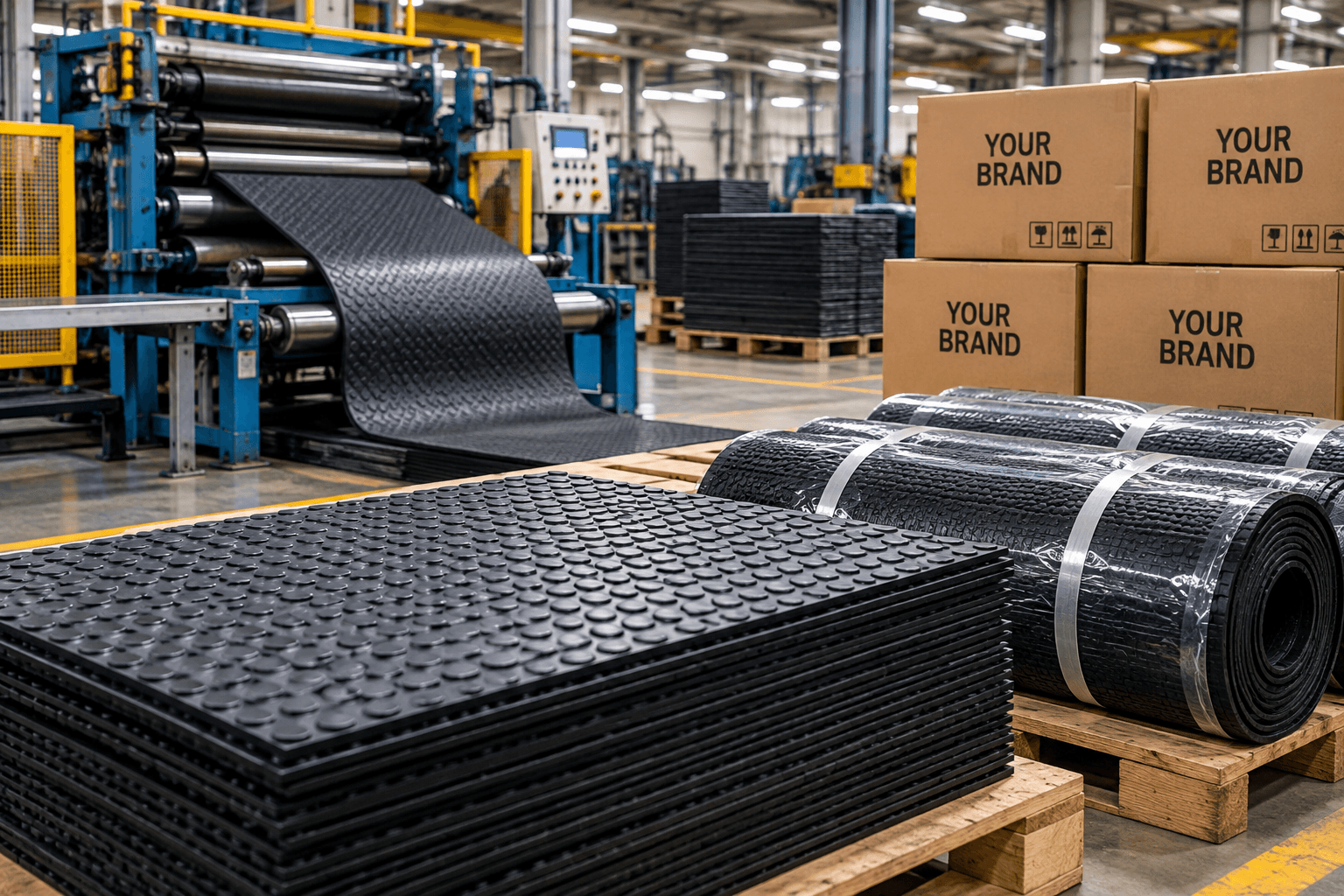
Packing also needs to suit the product’s dimensions and handling. Explain the destination and proposed distribution route so the relevant requirements can be discussed. Do not infer Highrange’s actual packaging or equipment from this article’s editorial illustration.
What International Buyers Should Confirm Before Ordering
International buyers should confirm the destination, specification, quantities, packing, shipment responsibilities, documentation and commercial terms together. Identify any applicable testing, certification or import requirements early and verify them with the appropriate parties; this guide does not provide customs or legal advice.
A requested certificate is not evidence that the supplier can provide it. Check which product and scope a document covers, and distinguish company credentials from product-specific results. For rubber mat sourcing from India, use the manufacturer’s published information to begin the discussion, then obtain confirmation for the actual order.
How to Evaluate an OEM Rubber Mat Manufacturer
Use the same questions when evaluating a custom rubber mat manufacturer or a supplier of bulk rubber mats:
- Are product dimensions, applications and available options clearly documented?
- Can the supplier distinguish a published feature from a proposed modification?
- Is manufacturing information available, and are unanswered specification questions identified?
- Can the parties establish suitable acceptance criteria and the evidence required?
- Are supported customization, documentation and export arrangements clear?
- Does the quotation identify exactly what will be supplied and what remains subject to confirmation?
Compare responses as well as prices
A useful response may identify a constraint or propose a supported alternative. For wholesale rubber mats, that clarity helps prevent a broad description from becoming an assumed commitment. Evaluate the documented offer rather than treating confident wording as proof of capability.
Highrange Manufacturing and Export Context
Highrange manufactures in Changanacherry, Kerala, India, with manufacturing experience since 1978. Its published manufacturing information describes in-house rubber compound preparation, quality control and finished-product manufacturing, including moulding, curing and finishing.
Its published capacity is nearly 24,000 kg of rubber compounds per day. This is compound capacity, not finished-mat output, export volume, spare capacity or guaranteed production availability.
Highrange’s export information states that it serves international commercial buyers and distributors and reviews OEM, private-label and product-development requirements against the product and programme brief. This supports an enquiry for review, not automatic availability of every custom size, branding method, sample or tooling service discussed in this guide.
What to Include in a Rubber Mat RFQ
RFQ means Request for Quotation. Bring the decisions above into one clear enquiry:
- Application, destination country and reference product or model, if known.
- Dimensions, thickness, format, surface and edge requirements, with drawings or photographs where useful.
- Operating environment, traffic, oils or other fluids, cleaning and required functional properties.
- Material or compound requirement if known, identifying questions that need supplier advice.
- Quantity and proposed packing, branding or private-label requirements.
- Required documentation or testing and the timing the buyer is working towards.
- Any reference samples available for discussion and details still awaiting confirmation.
Request review before assuming a solution
A complete brief helps the manufacturer determine whether an existing product fits, whether a modification needs assessment and what can actually be quoted. Mark essential requirements clearly and invite clarification on missing information. Providing a requirement is the start of review, not a guarantee that every requested customization can be supplied.
Frequently Asked Questions
What does OEM rubber mat manufacturing mean?
It generally concerns supply for another business’s product range or specification. Clarify whether the request involves a standard product, available options, a modification or new development.
What is the difference between OEM and private-label rubber mats?
OEM can concern the product specification and supply arrangement; private label concerns the buyer’s branding. The terms overlap in use, so define the actual product and branding requirements.
Can rubber mats be made in custom sizes?
Some products or manufacturers support particular options. Availability depends on the product and proposed change and must be confirmed; “custom” does not mean arbitrary dimensions are available.
What is the MOQ for custom rubber mats?
The minimum order quantity depends on the product, requested changes and order arrangement. Ask for confirmation against your specification; no Highrange MOQ is stated in this guide.
How long does OEM rubber mat production take?
Timing depends on the product, review or development needs, approvals and production arrangements. Confirm the quoted period and its starting conditions for the enquiry rather than assuming a standard lead time.
Can buyers request a specific rubber compound?
Yes, as a requirement for review. Explain the actual exposure and needed properties. A request does not establish formulation availability or suitability; the manufacturer must confirm what can be supported.
Should I request a sample before a bulk order?
Discuss whether a sample or another form of confirmation would help assess the requirement. Availability, cost and scope depend on the manufacturer and project; no Highrange sample or prototype service is promised here.
What information should I send to a rubber mat manufacturer?
Provide the application, dimensions, quantity, destination, operating conditions and required properties, together with proposed packing and relevant references. Distinguish essential requirements from preferences and unresolved questions.