
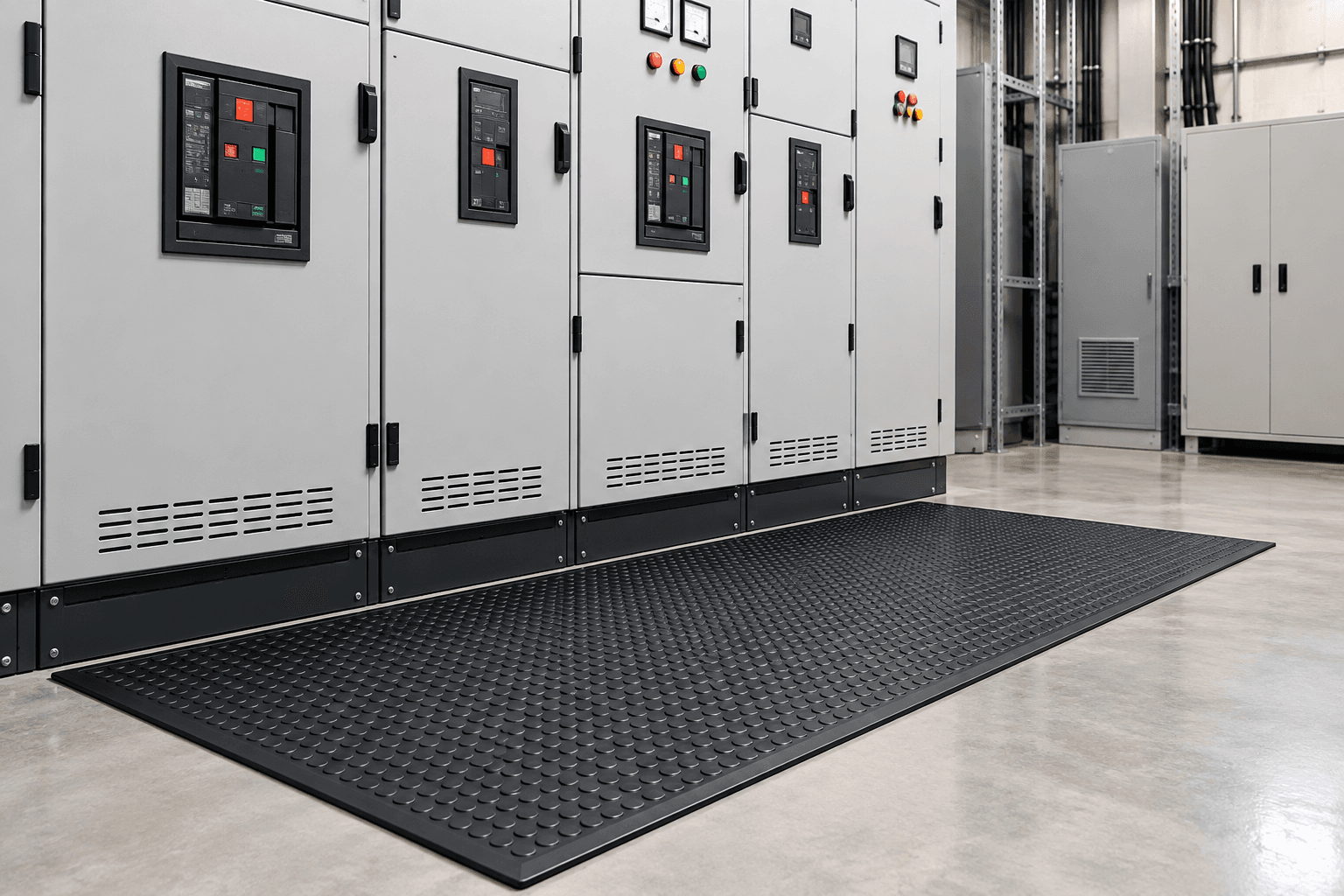
“Electrical safety mats” is a broad description. This guide focuses on electrical insulating mats: products with a documented insulation purpose for electrical work areas. It also explains why conductive ESD matting serves a different function and should not be selected as an insulating substitute.
For buyers, the essential questions are what function the workplace requires, what the individual product actually documents, and which specifications still need confirmation. Highrange’s Work Insular and Work Hawk provide insulation examples; Electra Tech provides the ESD contrast. Their published descriptions help frame an enquiry, but do not establish every rating or environmental condition a project may require.
What Are Electrical Insulating Mats?
Electrical insulating mats are working-area products selected for a documented electrical-insulation purpose. Highrange describes Work Insular and Work Hawk for indoor industrial electrical areas, with standing coverage forming part of their intended role. The appropriate choice depends on the product evidence and the requirements of that particular work area.
The phrase electrical safety mat can also appear in a broad product enquiry without identifying the required function. Clarify whether the buyer means insulation, static-charge control or simply floor coverage near electrical equipment. Those requests are not equivalent, even when the proposed products look similar.
This guide explains how to read the available information and prepare questions. It does not assign a safe operating voltage, approve a workplace arrangement or promise universal protection.
Why Not Every Rubber Mat Is an Electrical Safety Mat
A rubber appearance does not establish electrical insulation. Neither do colour, a raised pattern, thickness or an Industrial application label. These details can help identify a product or describe its physical layout, but they do not replace a documented electrical function.
When comparing electrical rubber mats, begin with the exact product name and its intended role. An ordinary floor covering, an insulating mat and a conductive ESD mat should not be treated as alternatives simply because all are used indoors.
Likewise, a description of grip or standing support answers a different question. Keep each required property attached to the evidence for that product, rather than combining features from several catalogue entries.
Electrical Insulation vs ESD and Conductive Matting
Work Insular and Work Hawk have electrical-insulation purposes. Electra Tech has conductive construction intended for ESD charge control: its published description says it channels excess static charge away and supports controlled discharge to an approved ground. It is not an electrical-insulation product.
That difference should be settled before comparing sizes or requesting a quote. A request for static control should not become an insulation order, and a request for insulation should not be answered by selecting a conductive product with grounding wording. The intended electrical function is the first filter.
Electra Tech publishes “1 × 10³ to 1 × 10⁶ Ω resistivity”. Its benefit wording also uses resistance. The available information does not supply the full measurement definition or test conditions, so retain the published wording and ask for clarification rather than reinterpreting the number.
Its approved-ground description establishes the intended charge-control role, not a grounding-system specification or connection procedure. Use the product page for the ESD enquiry; this article concentrates on the insulation-selection distinction.
Breakdown Strength Is Not Working Voltage
Work Insular’s published statement is “Up to 20,000 V breakdown strength”. Keep the words breakdown strength with the figure whenever it is discussed. The current product information does not establish that 20,000 V is an allowable working voltage or safe operating voltage.
It also does not provide the AC/DC basis, test conditioning, duration or specimen details behind that statement. A buyer cannot derive a voltage class or fill those missing conditions by comparing the figure with another product. No conversion or selection equation is supported here.
Work Hawk has no numerical voltage rating in its published record. Its insulation purpose and qualitative shock-protection wording should therefore remain separate from any project requirement for a specified electrical rating.
Put the workplace’s required allowable-use information into the enquiry and ask for the applicable product documentation. A prominently displayed number is useful only when its meaning and limitations are preserved; it is not a substitute for resolving the actual specification.
Start with the Electrical Work Area and Required Function
Describe the equipment area and the task being considered, then state whether insulation or ESD/static control is required. Include the intended location, existing floor and whether the environment is indoors. The three examples in this guide are documented for indoor use; their descriptions should not be extended to outdoor service.
Record the coverage dimensions and where people stand, turn or move between positions. Identify surface and footing needs, nearby transitions, and any environmental or moisture conditions that could affect selection. Keep a drawing or measured layout with the enquiry so coverage is not reduced to an estimated mat size.
Finally, identify the documentation the project requires and the questions that remain unanswered. For broader industrial coverage decisions, use the industrial mat guide. Electrical selection needs its own review rather than inheriting assumptions from general factory flooring.
Surface Grip and Standing Coverage
Work Hawk provides the explicit grip example: its published anti-slip surface and textured finish support footing in its intended electrical workplace. These qualitative descriptions do not guarantee slip prevention or establish suitability under every surface condition.
Work Insular is described as providing a defined standing surface. That wording does not establish an anti-slip rating, cushioning or anti-fatigue performance. Electra Tech’s resilient description likewise should not be converted into an anti-fatigue claim.
Describe the standing footprint and required footing separately from the electrical function. A product must be assessed against both questions; a surface pattern alone cannot answer the electrical requirement.
Moisture and Environmental Conditions
Work Insular includes moisture-absorption wording, with a surface described as helping manage moisture around standing positions. This is a published product characteristic, but moisture absorption is not evidence of verified wet-service electrical suitability.
Current product records do not establish verified wet-service electrical suitability for Work Insular, Work Hawk or Electra Tech. All three are listed as Indoor. Indoor classification alone does not resolve a situation involving wet or changing conditions.
Describe the actual environment, including moisture and any substances that may contact the mat, and request applicable documentation. Do not transfer drainage, oil resistance or cleaning compatibility from another Highrange product. Keep environmental suitability as an unresolved question until the specific requirement has been reviewed; this guide does not prescribe procedures for wet electrical work.
Size, Thickness and Custom Configuration
Work Hawk lists 91 × 91 × 1.4 cm and a custom-size option. The 1.4 cm thickness belongs to that listed size. It is a physical dimension, not an electrical class or a basis for assigning protection to a different mat.
Work Insular lists custom size without numerical dimensions or thickness. Electra Tech lists custom configurations without numerical dimensions or thickness. Request the needed details instead of measuring a photograph, borrowing Work Hawk’s thickness or assuming every custom configuration is available.
There is no supported universal thickness recommendation or thickness-to-electrical-rating relationship in these records. Confirm coverage and any specified thickness alongside the documented electrical purpose. If a project requires a particular configuration, ask how that exact configuration is identified in the supporting product information.
Product Documentation Buyers Should Verify
Start with the exact product identity and the intended electrical function. Keep the product name, published performance wording and proposed configuration together. A document for a different product or an unspecified sample does not resolve the evidence gap for the item being ordered.
Communicate any project-specific standards, certification or allowable-use requirements and request applicable supporting information. This is a buyer verification step: it does not mean the current Highrange records publish those certifications or ratings. Company credentials do not establish a product’s electrical qualification.
Check whether the available information covers the intended environment, dimensions, thickness where relevant and custom configuration. Ask for applicable installation and care documentation as well as clarification of unresolved electrical terms.
It is useful to separate an enquiry into three parts: what the product currently states, what the project requires, and what still needs confirmation. That makes missing information visible and avoids treating a request for evidence as if the evidence had already been supplied.
Highrange Examples: Insulation and ESD Have Different Roles
These examples illustrate selection questions rather than a performance ranking. All three are Special Purpose industrial mats for indoor use, but their electrical roles differ.
- Insulation with published breakdown wording → Work Insular, HR-042. Its record establishes insulating construction, moisture absorption and “Up to 20,000 V breakdown strength”. Allowable working voltage, test details and environmental suitability still need verification.
- Insulation with a textured standing surface → Work Hawk, HR-043. Its record establishes an insulation purpose, an anti-slip surface and qualitative wording about reducing electrical-shock exposure. It does not publish a numerical voltage rating or electrical class.
- Static-charge control → Electra Tech, HR-041. Its conductive construction supports ESD discharge to an approved ground. It is not an insulating alternative; full measurement details and configuration information remain questions for the relevant ESD enquiry.
Care and Inspection Information to Request
Ask for product-specific information addressing installation, physical condition, care, inspection and retesting where applicable. The current records do not establish procedures or intervals for these products. Do not invent a cleaning agent, inspection schedule, replacement interval or electrical retest frequency.
Clarify which information applies to the proposed product and configuration, and who will resolve unanswered requirements before use. A general description of durability is not a numerical service life or warranty.
The durability guide explains broader mat-selection considerations. It does not establish electrical safety, confirm continued insulating performance or replace applicable product-specific instructions.
Electrical Mat Selection and Enquiry Checklist
Send a clear brief that distinguishes requirements from verified product properties. Standards and certifications listed in your enquiry are buyer requirements to communicate, not claims that these products hold them.
- Required function: electrical insulation or ESD/static control, with the work area and application identified.
- Placement: indoor environment, existing floor, measured dimensions, required coverage and worker movement.
- Surface and exposure: footing or grip needs, moisture and other environmental conditions.
- Electrical evidence: published voltage or breakdown wording, unresolved working-voltage requirement and required product documentation.
- Project requirements: any specified standard or certification, clearly marked for confirmation against the proposed product.
- Configuration: thickness if specified, supported custom sizing or configuration, quantity and delivery destination.
- Open questions: applicable installation and care information needed, measurement ambiguities and any unresolved technical requirements.
Frequently Asked Questions
What is an electrical insulating mat?
It is a mat with a documented electrical-insulation purpose for the intended work area. Work Insular and Work Hawk are Highrange examples. Their descriptions establish that purpose, but buyers still need to confirm the requirements and applicable documentation for their specific workplace.
Are all rubber mats electrically insulating?
No such assumption should be made. Rubber appearance, colour, thickness or industrial use does not establish an insulation specification. Check the exact product’s documented function; a conductive ESD mat has a different purpose from an insulating mat.
What is the difference between an ESD mat and an electrical insulating mat?
An ESD product such as Electra Tech uses conductive construction for static-charge control and controlled discharge to an approved ground. Work Insular and Work Hawk instead have insulation purposes. Electra Tech must not be treated as an electrical-insulation option.
How do I choose an electrical safety mat?
Identify the electrical function first, then describe the work area, environment, coverage and footing needs. Compare those requirements with individual product information. Request missing electrical documentation and configuration details before treating a candidate as suitable for the proposed use.
Does a 20,000 V breakdown-strength claim mean a mat can be used at 20,000 V?
No. Work Insular’s “Up to 20,000 V breakdown strength” statement does not establish an allowable 20,000 V working voltage or safe operating voltage. The published record also lacks the test conditions needed to interpret the figure more fully. Request the applicable allowable-use documentation.
Does mat thickness determine electrical protection?
Thickness alone does not establish electrical protection or a voltage class. Work Hawk lists a 1.4 cm thickness for its stated size, while Work Insular and Electra Tech publish no thickness. These dimensions cannot be converted into an electrical rating.
Can electrical insulating mats be used in wet areas?
Current product records do not establish verified wet-service electrical suitability. Work Insular’s moisture-absorption wording does not change that limitation. Describe wet or changing conditions and obtain applicable product-specific information instead of assuming suitability from an indoor classification or moisture claim.
What should buyers verify before ordering electrical insulating mats?
Verify product identity, intended electrical function, applicable performance documentation, environment, dimensions and configuration. Communicate project-specific requirements, quantity and destination. Keep missing ratings, test information and installation or care instructions listed as unresolved questions rather than presumed product capabilities.