An oil-resistant rubber mat should be selected from the actual operating exposure, not from the word “rubber” or an industrial appearance. A workshop floor can involve lubricants, process fluids, cleaning substances, standing work and coverage requirements at the same time. Each is a separate part of the brief.
This guide helps industrial buyers turn oil or fluid exposure into a clear selection and enquiry process. It focuses on the information to identify, the published evidence to compare and the questions that remain before a mat is specified for a particular work area.
What Are Oil-Resistant Rubber Mats?
Oil-resistant rubber mats are products with published evidence relevant to oil exposure. That is narrower than calling a mat industrial, textured or heavy duty. A suitable product still has to match the actual fluid, location, coverage and other functions required at the workstation.
The term can describe a defined floor mat beside equipment or a coverage solution for a work area. It does not establish a permanent industrial flooring system, universal chemical resistance or compatibility with every substance found in a workshop. Start by defining what the mat must do around the actual operation.
Why Oil Exposure Needs a Specific Mat Selection
A dry industrial standing area and an area with recurring oil contact are different selection problems. Rubber alone does not establish oil compatibility, and an industrial application label does not supply it either. Look for the relevant property in the individual product record, then compare its stated scope with the conditions at the site.
Name the process rather than relying on a broad description such as “workshop flooring”. Include whether people stand in one position, walk through the area, move equipment or need wider coverage. This keeps an oil-exposure requirement from being confused with grip, standing support or layout needs.
A useful brief treats missing evidence as an open question. It is better to request confirmation for a named exposure than to combine claims from several mats into an assumed all-purpose solution.
NBR in Oil-Resistant Rubber Matting
NBR means nitrile butadiene rubber. It is a material designation that buyers may encounter when oil exposure is relevant. Material identity and finished-product suitability remain different questions: the named product and the actual exposure must still be reviewed together.
NBR is not the whole selection process. It does not, by itself, identify compatible fluids, temperature limits, contact duration, surface grip or a drainage arrangement. Use it to help identify a product candidate, then assess the published product information and unresolved requirements for the work area.
NBR Content Is Not the Whole Specification
Guard Tech publishes 50%, 80% or 100% NBR options. Those are useful product options to raise in an industrial-fluid enquiry, but the current product data does not define their measurement basis. They must not be read as acrylonitrile content, purity, chemical concentration, an oil-resistance percentage or a performance rating.
Do not rank those options from the number alone. A higher published option does not automatically establish better performance for every oil, process fluid or workshop condition. The selection needs the named substance, how contact occurs and the remaining product requirements.
A compound option also does not replace the finished-product specification. Dimensions, environment, coverage, surface needs and any separate functions still have to be reviewed.
Start with the Actual Oil or Industrial Fluid
A buyer should identify the actual oil or industrial fluid where possible, rather than describing the environment only as oily. Record whether the material comes from machinery, a maintenance task, a product being handled or another source. If several substances are present, list them separately.
The published Guard Tech record concerns oil and other industrial fluids and resistance to swelling around those exposures. It does not publish a compatibility matrix. For that reason, a named fluid is information for supplier review, not a claim that the product is already approved for it.
Cleaning products also belong in the brief when compatibility matters. A cleaner can be a separate exposure even if the operating oil does not change. Do not assume a product intended around industrial fluids is compatible with every cleaning agent.
Contact Pattern, Repeated Exposure and Pooling
Explain how the substance reaches the proposed mat: occasional drips, repeated contact, surface wetting, splashes or liquid that can remain on or beneath the coverage. These conditions are not automatically equivalent, and the repository does not publish a universal exposure-duration limit for Guard Tech or another mat.
Describe whether the area is cleaned promptly, whether fluid can collect at an edge and whether the floor beneath needs access for inspection. These details help distinguish a general coverage request from an exposure-specific product review.
Avoid turning a site observation into a performance conclusion. The presence of pooling does not establish that a mat should provide drainage, nor does a mat’s surface appearance establish how a particular fluid will behave.
Oil Resistance Is Not Universal Chemical Resistance
Oil resistance and universal chemical resistance are not equivalent claims. Guard Tech is described as oil and fluid resistant and as resisting swelling around industrial fluids. That wording does not establish fuel, solvent, acid, alkali, hydraulic-fluid or cleaner compatibility.
Do not extend a material name into a complete chemical-compatibility statement. If a project needs documentation for a particular substance, exposure or standard, identify that requirement and request the applicable information. The current product record does not publish oil test results, swelling percentages, hardness change, tensile retention or a named test standard.
This distinction protects the specification from broad terms that sound useful but do not answer the project’s actual question.
Oil Resistance vs Grease Resistance
Oil and grease exposure should be considered in their own application contexts. Guard Tech is the Highrange industrial oil-and-fluid example. Work Top Pro is a separate indoor Food Service mat with published grease resistance, anti-fatigue cushioning and lightweight construction for restaurant and kitchen work areas.
Work Top Pro’s food-service grease wording does not identify it as an NBR product or establish general industrial oil, fluid or chemical compatibility. Its published role also does not establish drainage or a slip rating. Conversely, Guard Tech’s oil/fluid evidence does not establish anti-fatigue, drainage or grip performance.
Use the product whose documented role fits the actual environment, then seek clarification where the stated claim does not answer a required condition.
Grip, Drainage and Anti-Fatigue Are Separate Requirements
An oil-exposure brief may also mention footing, water handling or prolonged standing. Each function needs its own evidence. A textured surface does not establish oil compatibility; drainage does not establish chemical compatibility; and cushioned construction does not establish oil resistance.
For example, Ringmax publishes open-ring water drainage and wet-area footing, while Work Easy publishes industrial anti-fatigue support. Neither product has a published oil or NBR compatibility claim. These are useful distinctions when a workplace needs several functions at once.
Guard Tech should not be described as anti-fatigue, slip resistant, draining or safe for wet use because those properties are not published for it. Keep every required function visible in the enquiry rather than assuming one product feature covers another.
Size, Coverage and Workplace Configuration
Exposure suitability is only part of the choice. Measure the standing position, work zone, aisle boundary and any equipment movement before selecting coverage. A mat that is suitable for a named exposure can still be the wrong format or footprint for the area.
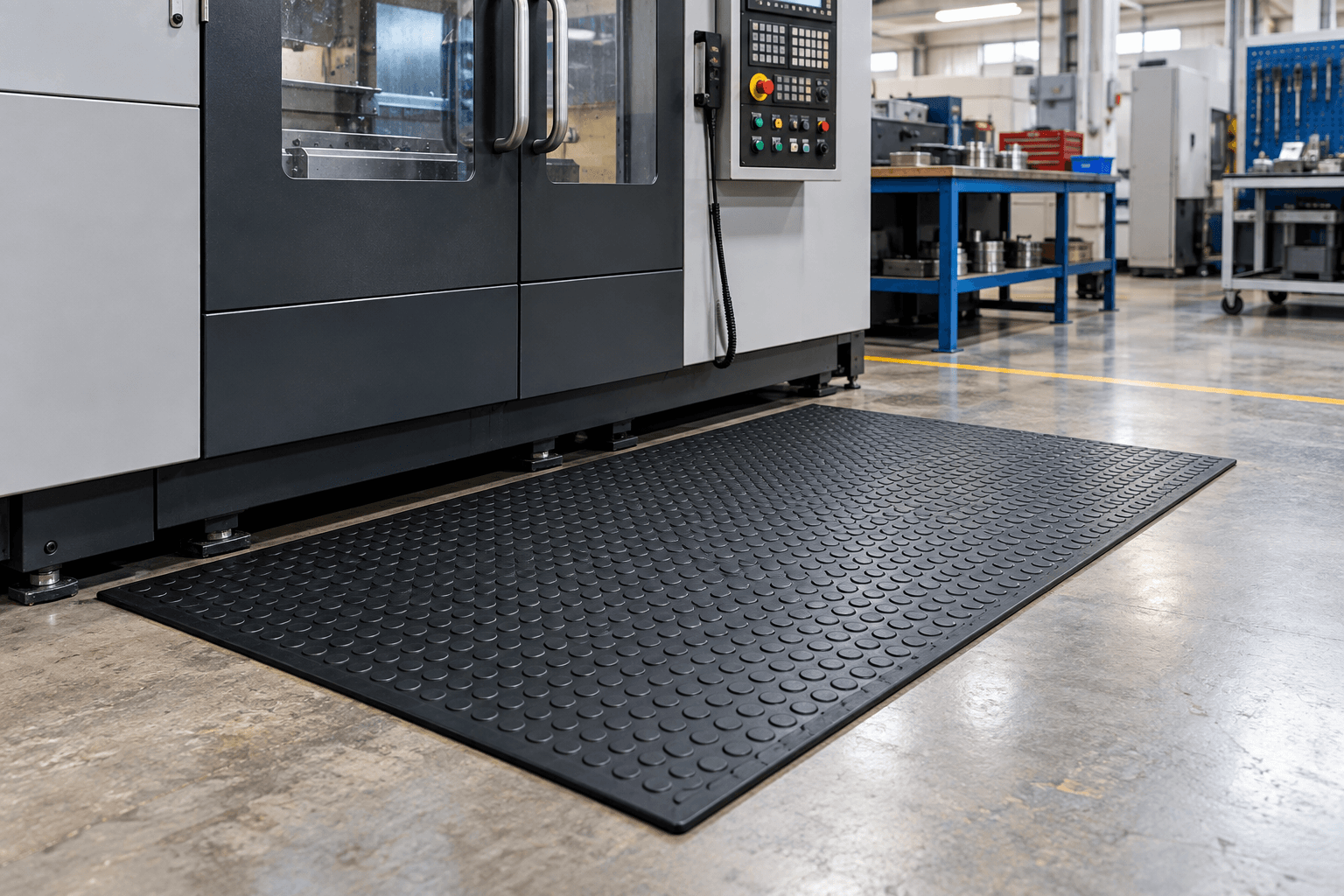
Guard Tech is listed in black at 90 × 150 cm with a custom-size option, for indoor or outdoor industrial work areas. These are its published dimensions and environment. The current data does not publish a thickness, so it should not be estimated from an image or borrowed from another product.
Confirm how the proposed coverage relates to edges, access and the existing floor. The product’s alternative designs are published options, but a desired pattern or configuration still needs confirmation for the specific enquiry.
Guard Tech: Published Oil/Fluid Evidence and Its Limits
Guard Tech is the primary Highrange example for industrial oil and fluid exposure. It is a Special Purpose industrial mat, listed for indoor or outdoor use. Its record describes specialised rubber designed to resist swelling when exposed to oil and other fluids, and lists oil and fluid resistance with 50%, 80% or 100% NBR options.
The published record also gives a 90 × 150 cm listed size, a custom-size option, black colour and alternative designs. These facts make it a product to discuss when industrial fluids may contact the floor surface.
Buyers may still need to verify the exact fluid, conditions of contact, cleaning substances, required documentation, coverage configuration and any additional safety or performance function. The catalogue does not provide a fluid matrix, named compatible oils, temperature limits, duration limits, test results, thickness, drainage, grip or anti-fatigue information for Guard Tech.
What Buyers Should Verify Before Ordering
A clear enquiry lets the product review focus on the relevant uncertainties. Separate what is known from what still needs confirmation, and do not use a requested property as proof that it is already available.
Where the project has a purchasing, safety or maintenance review, say what evidence is required before a decision can be made. This may include confirmation about the named exposure, dimensions, configuration or another separate function. Giving the supplier the actual decision criteria is more useful than asking whether a mat is simply “oil resistant”. Document the response against the stated workplace need.
- The exact oil, grease or industrial fluid, together with other substances that can contact the mat.
- How contact occurs: drips, repeated surface exposure, splashes, pooling or contact beneath the coverage.
- The indoor or outdoor environment, existing floor, work activity and required area of coverage.
- Published product dimensions or format under consideration, plus quantity and destination.
- Separate requirements for footing, drainage, standing support, cleaning access or other specialist functions.
- Cleaning products where compatibility is relevant, and any technical documentation the project requires.
- Photographs, layouts or equipment locations that help explain the proposed workplace configuration.
Frequently Asked Questions
What is an oil-resistant rubber mat?
It is a mat with published evidence relevant to oil exposure. The product still needs to match the actual fluid, contact conditions, coverage and other workplace requirements. An industrial appearance or rubber construction alone does not establish oil resistance.
What does NBR mean in a rubber mat specification?
NBR means nitrile butadiene rubber. It is a material designation that may be relevant to oil exposure, but it does not by itself provide a complete compatibility, temperature, grip or drainage specification.
Are all rubber mats resistant to oil?
No. Check the individual product’s published information. General rubber construction, a textured surface or industrial application wording does not establish oil compatibility.
Is oil resistance the same as chemical resistance?
No. An oil-resistance claim does not establish universal chemical compatibility. Identify the actual substances and request relevant product information when chemical compatibility is important.
Is grease resistance the same as industrial oil resistance?
Not automatically. Work Top Pro has published grease resistance for indoor food-service use, while Guard Tech has a separate industrial oil-and-fluid role. Each claim must be matched to its stated application and the actual exposure.
Does a higher NBR percentage automatically mean a better oil-resistant mat?
No. Guard Tech lists 50%, 80% and 100% NBR options, but the current record does not define the percentage basis or present them as performance ratings. Review the actual exposure and product information instead of ranking them by the number alone.
Do drainage, grip or anti-fatigue features prove that a mat is oil resistant?
No. Those are separate functions. A drainage, textured or cushioned product needs its own published oil-compatibility evidence before it is selected for an oil-exposed area.
What information should buyers provide when enquiring about an oil-resistant rubber mat?
Provide the actual substances, how and how often contact occurs, the environment, floor layout, required coverage and any separate function or documentation requirement. Include cleaning products where compatibility matters.