
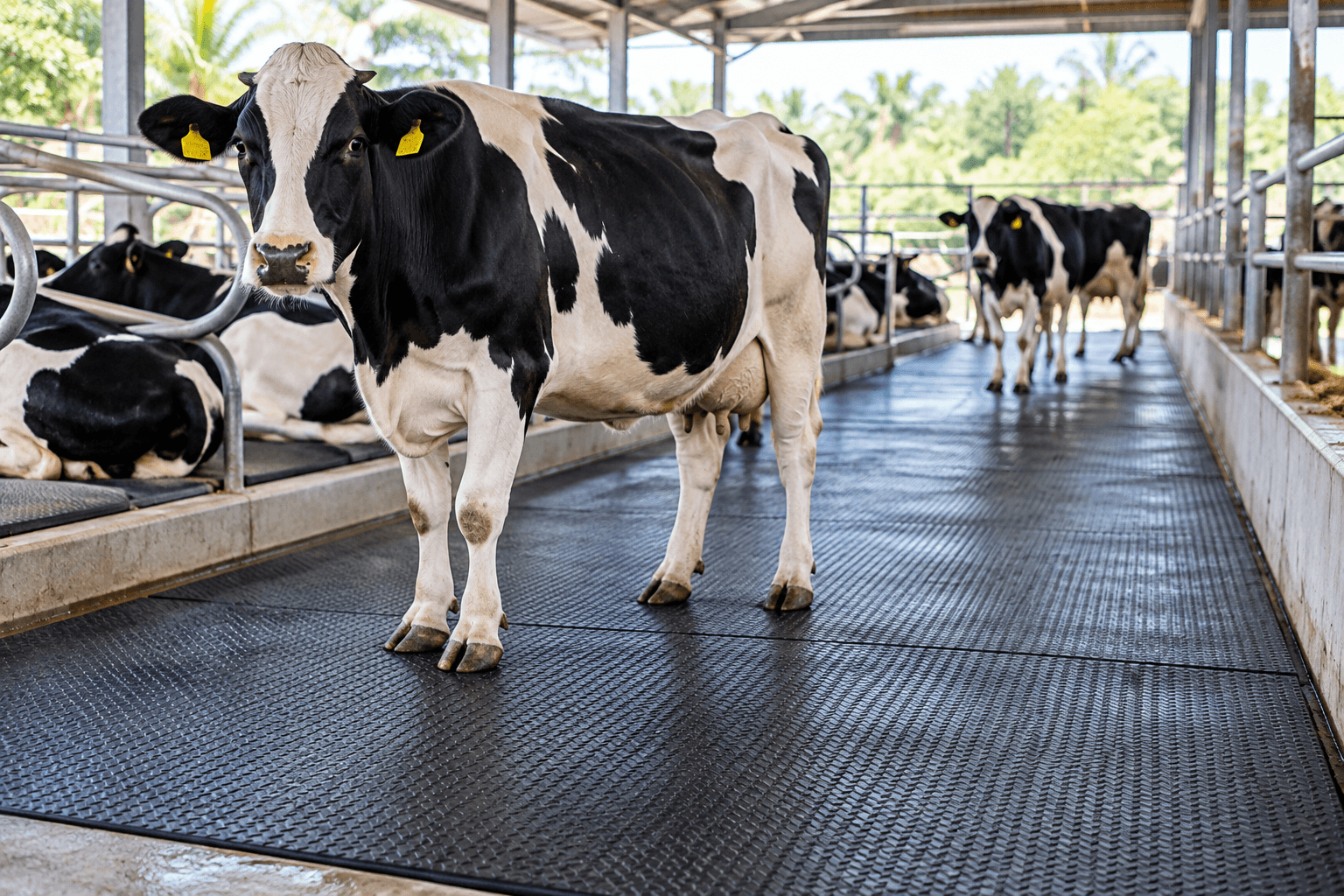
Choosing rubber cow mats starts with the dairy area, not a preferred thickness or a photograph of a surface pattern. A cubicle resting surface, a holding area and a cattle passage have different purposes. The useful question is which product fits the location, floor and daily routine.
For dairy farmers, farm owners, distributors and importers, this guide connects those requirements with published product information. It explains what to compare, what still needs confirmation and how to prepare a clear enquiry for dairy farm rubber mats.
What Are Rubber Cow Mats?
Cow mats are resilient floor coverings selected for particular dairy or cattle areas. The category includes defined resting mats, holding-area and milking-area mats, connected passage coverage and continuous cow-mat rolls. These formats describe different ways of covering a floor, not interchangeable solutions.
When comparing rubber mats for cows, identify the stated application alongside the size and construction. A product described for indoor cubicles should not automatically be extended to an outdoor passage. Likewise, general livestock flooring or barn flooring descriptions do not establish suitability for every animal, location or activity.
Start with the Dairy Area and Its Requirements
Define what happens in the area before comparing cattle mats. Record whether the location is used for resting, holding, milking or movement, then describe the existing floor, coverage, exposure and cleaning routine.
- Cubicles and resting areas: assess the defined space, mat footprint and documented resting-surface construction.
- Holding areas: consider animal movement, positioning and the selected product’s fixing arrangement.
- Milking areas: check the supported location, surface and access for routine cleaning.
- Cattle passages: plan connected coverage around the actual walking route and adjoining surfaces.
- Continuous cowpen floors: establish the width and length required before choosing a roll format.
Cow Comfort: What Product Specifications Can Tell You
Published cushioning and resting-support information helps distinguish dairy cow mats. Shelter Mate describes resilient cubicle support; Shelter Lock Pro uses bottom studs beneath resting cattle; Shelter Soft uses a soft latex foam-filled internal layer. These are specific construction descriptions, not evidence that all rubber mats perform alike.
Compare the intended location and construction together. A thick mat intended for a resting area is not automatically a passage-floor solution. Ask how the proposed product fits the site rather than choosing by a broad “comfort” label alone.
Comfort and cushioning are selection considerations. They do not establish improved milk yield, hoof or joint health, injury prevention or increased lying time. Those outcomes cannot be concluded from the published dimensions or a product photograph.
Materials and Construction
Highrange explicitly identifies natural rubber for Shelter Mate, Shelter Stud and Shelter Walk. Shelter Soft specifies latex foam filling; that describes its internal construction, not the composition of the whole product. The other Dairy entries do not publish a specific polymer formulation.
A material name alone does not determine finished-product suitability. Compare the surface, underside, supported location and coverage format as well. Bottom studs, a shaped rear and a reversible surface have different roles and should be checked against the selected model.
If a compound or resistance property matters to the enquiry, state the actual exposure and ask for supporting product information. Do not assume that a feature published for another rubber mat also applies to a dairy product.
Surface Grip, Moisture and Drainage Are Different Questions
Surface descriptions can support a shortlist. Shelter Stud publishes an anti-slip hammer top; Shelter Max has diamond-pattern grip; Shelter Walk describes a textured high-grip surface for cattle passages. These claims remain specific to those products and do not provide a universal slip rating or guarantee against slipping.
Texture does not automatically establish drainage. None of the nine Dairy products compared below publishes drainage capacity. A studded underside, surface pattern or connected layout should not be interpreted as a verified system for moving urine, manure or liquid.
Describe where moisture occurs, what contaminants are present and how the existing floor handles liquids. Ask how the proposed matting will work with that arrangement and how the area can be inspected and cleaned. Treat unresolved liquid-management requirements as questions for site and product review, rather than filling the gaps with assumptions.
Choosing Cow Mat Size and Thickness
Begin with measured coverage and the intended product footprint. Record the area dimensions, obstructions, adjoining surfaces and any layout constraints. Check the published size order and units before comparing quotations; a small difference in width can matter to a defined cubicle.
The listed range includes 17 mm Dairy Max rolls, 20 mm mats, 24 mm cubicle mats and the 30 mm Shelter Soft. These are product specifications, not a ranking of comfort, quality or durability. A foam-filled construction and a studded mat cannot be compared meaningfully by thickness alone.
Confirm which listed size fits the area and what further installation information is required. Do not assume that every mat can be trimmed, supplied in arbitrary dimensions or used wherever its footprint fits. Cut-to-length supply is expressly published for Dairy Max; it should not be generalized to the other products.
Individual Mats, Connected Coverage or Cow-Mat Rolls?
Individual mats provide a defined footprint for an identified area. Compare that footprint with the proposed layout, including boundaries and transitions. Where several mats are involved, ask how the selected model should be positioned and how adjoining edges are handled.
Shelter Walk describes connected mats providing seamless passage coverage. The published information does not specify the connection mechanism, so do not infer interlocking edges or a particular fitting method. Dairy Max instead provides continuous indoor cowpen coverage in two listed widths, supplied at 30 m or cut to length.
Choose the format around the dairy flooring plan, cleaning access and supported application. A roll is not automatically better than individual mats, and the range does not imply that every model is offered as a mat, tile and roll.
Floor Preparation and Installation Questions
Before ordering, provide photographs or a drawing of the existing floor and proposed coverage. Identify uneven or damaged areas, transitions and indoor or outdoor exposure for review. These details help clarify whether the proposed product and installation arrangement suit the location.
Shelter Max publishes recessed fixing holes and stainless-steel fixings for holding-area placement. That information does not establish fixing instructions for another model. Obtain the selected product’s installation guidance rather than adopting a universal adhesive, fixing pattern or floor-preparation method.
- Confirm the supported location, floor condition and dimensions with the supplier.
- Clarify the model-specific fixing requirements and treatment of edges or adjoining coverage.
- Plan access for cleaning and inspection, including beneath or between mats where relevant.
- Resolve unanswered installation questions before treating a layout as ready for fitting.
Cleaning Access and Routine Maintenance
Cleaning-related wording is product-specific. Shelter Mate’s hammer top supports routine cleaning; Shelter Stud describes easier cleaning; Shelter Queen’s rubber finish supports routine wash-down. These statements do not establish antibacterial performance or compatibility with every cleaning product.
Explain the farm’s cleaning routine, equipment and substances when discussing rubber flooring for dairy farms. Ask for guidance covering the selected model, its placement and access around the coverage. Confirm compatibility before specifying chemicals or disinfectants; the published entries do not supply chemical concentrations or a universal cleaning procedure.
Include cleaning access in the selection decision, not only after installation. Note areas that are difficult to reach or inspect and raise them during layout review. An easy-clean surface description does not establish disease or mastitis prevention.
Assessing Wear and Replacement Needs
Review condition against the mat’s intended function. Cracking, tearing, edge damage, deformation, movement or surface wear should prompt assessment of the product and its placement. Record where changes occur and whether they affect coverage, positioning or the supported use.
If continued use is questionable, follow the farm’s procedures and seek supplier guidance. A photograph may document a concern but does not establish its cause. Review the operating conditions and cleaning history when discussing replacement.
There is no published universal service life for this Dairy range. Qualitative durability wording does not justify an invented number of years, warranty or replacement-cost saving.
Highrange Rubber Mat Options by Dairy Application
The following black Dairy products illustrate different selection routes. Use the individual product pages for the full published specification and confirm the proposed application before ordering.
Cubicle resting surfaces
Shelter Mate — HR-025: indoor natural-rubber mat, 120 × 180 × 2.4 cm or 115 × 180 × 2.4 cm. Its hammer top supports grip and routine cleaning, with resilient cubicle cushioning.
Shelter Lock — HR-026: indoor cubicle mat in 120 × 180 × 2.4 cm or 115 × 180 × 2.4 cm. A slope-edged rear and resilient rubber support cushioning and a natural resting position.
Shelter Lock Pro — HR-028: indoor 120 × 180 × 2.4 cm cubicle mat. Bottom comfort studs provide cushioning beneath resting cattle, with easy-installation and sustained-use wording.
Shelter Soft — HR-029: indoor 120 × 180 × 3.0 cm cubicle mat. Latex foam filling and a slope-edged rear provide mattress-like cushioning and natural lying-position support.
Defined cattle, holding and milking areas
Shelter Stud — HR-027: indoor natural-rubber cattle-area mat, 120 × 180 × 2.0 cm. Bottom studs provide cushioning; its anti-slip hammer top supports grip and easier cleaning.
Shelter Max — HR-030: indoor/outdoor holding-area mat, 120 × 180 × 2.0 cm. Diamond-pattern grip, recessed fixing holes and stainless-steel fixings support planned positioning.
Shelter Queen — HR-031: indoor milking-area mat, 100 × 100 × 2.0 cm. Both faces are usable; its coin pattern supports footing and the rubber finish supports routine wash-down.
Passages and continuous cowpen coverage
Shelter Walk — HR-032: indoor/outdoor natural-rubber passage mat, 122 × 182 × 2.0 cm. Its textured high-grip surface and connected coverage support cattle walking areas.
Dairy Max — HR-033: indoor cow-mat roll with 120 cm width × 17 mm thickness or 180 cm width × 17 mm thickness; 30 m or cut to length. It supports cattle comfort and continuous cowpen coverage.
Buyer Selection and Enquiry Checklist
Bring the site requirements and product shortlist together in one brief. Farmers and commercial buyers can use the same checklist; distributors should obtain the intended installation details rather than relying on the phrase “cow flooring”.
- Dairy area and activity, with indoor or outdoor placement clearly identified.
- Existing floor, layout, coverage dimensions and photographs or drawings where useful.
- Individual mats or continuous coverage, reference model, listed size and thickness under consideration.
- Surface requirements, moisture or liquid conditions and the current cleaning routine.
- Installation and fixing questions, transitions and access for cleaning or inspection.
- Quantity, destination and any product-specific documentation required for review.
Frequently Asked Questions
How do I choose rubber mats for a dairy farm?
Start with the dairy area, activity, existing floor and cleaning routine. Then compare the supported application, format, dimensions and construction of the proposed product. Confirm unresolved installation or performance requirements before ordering.
Can the same cow mat be used in cubicles and cattle passages?
Do not assume so. Cubicle resting mats and passage products have distinct published roles. Check the selected model’s supported application and the proposed layout rather than extending a cubicle specification to every cattle area.
What thickness cow mat should I choose?
There is no universal thickness recommendation. Compare the intended area, construction and listed size together. Thickness alone does not establish comfort, quality or lifespan.
How do I select the right cow-mat size?
Measure the intended coverage and record obstructions and adjoining surfaces. Compare those requirements with the published dimensions, then confirm fitting details. Do not assume arbitrary sizes or trimming are available for every model.
When is a cow-mat roll preferable to individual mats?
A roll may suit long, continuous coverage where its stated application and width fit the layout. Dairy Max is an indoor cowpen roll; individual mats provide defined footprints for their supported dairy areas.
Does a textured cow mat also provide drainage?
Not automatically. Texture or grip wording does not establish liquid flow or drainage capacity. Explain the site’s moisture conditions and verify the required arrangement separately.
How should cow mats be cleaned?
Request guidance for the selected model and explain the farm’s cleaning routine. Published easy-clean wording does not confirm compatibility with every chemical or disinfectant. Plan access for inspection and cleaning as part of selection.
Can dairy rubber mats be used outdoors?
Only where the chosen product supports that environment. Shelter Max and Shelter Walk are listed for indoor/outdoor use; the other seven Dairy products discussed here are listed for indoor use.